Lesson · Grade 7 · Mathematics
Reading the rule from a graph
- Grade 7
- Mathematics
- 1 min 17 s
- British Columbia
- BC7-MA-38
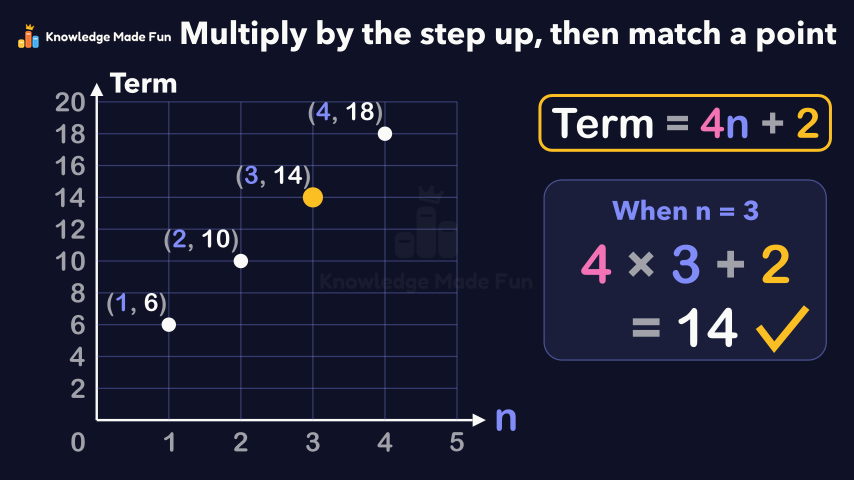
Students read the points (1, 6), (2, 10), (3, 14) and (4, 18) off a graph and see that each step across 1 goes up 4, so the rule multiplies n by 4. Testing the first point shows it is 2 higher than 4n, which gives the rule Term = 4n + 2, and the point for n = 3 confirms it.
Anyone can watch two lessons on the website without an account. Signing in is free, no payment and no card, and opens three a day; Plus has no limit.
Loading
In one sentence
The question this lesson answers
This graph shows a pattern, with the term number n across the bottom and the term up the side.
How can we find the rule that turns each n into its term?
Transcript
What the lesson says
This graph shows a pattern, with the term number n across the bottom and the term up the side.
How can we find the rule that turns each n into its term?
First, read each point: down to find n, and across to find the term.
The first point is at n equals 1, with a term of 6.
The other points have terms 10, 14 and 18.
From each point to the next, we go across 1 and up 4.
Going up 4 for each step across means the rule multiplies n by 4.
Test it on the first point. When n is 1, 4 times 1 is 4.
But the point is at 6, which is 2 more, so we add 2.
So the rule is 4 times n, plus 2.
Check the rule with another point, where n is 3.
4 times 3 is 12, plus 2 is 14, just like the graph.
To read the rule from a graph, multiply n by how far each step goes up, then use one point to find what to add or subtract.
Curriculum
Where this fits
- British Columbia, Grade 7
Mathematics, Patterns and algebra: discrete linear relations, using expressions, tables, and graphsBC7-MA-38
Previous: Graphing a Linear Relation from Its TableNext: What the two numbers in 3n + 2 mean
The outcomes and strands follow the British Columbia curriculum.
Keep going
 1 min 8 s
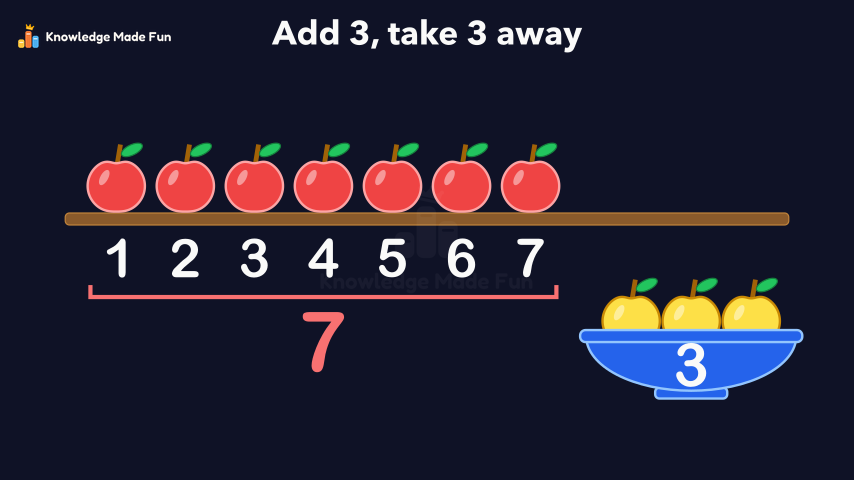
7 and 3 More Makes 10
Grade 1 · 1 min 8 s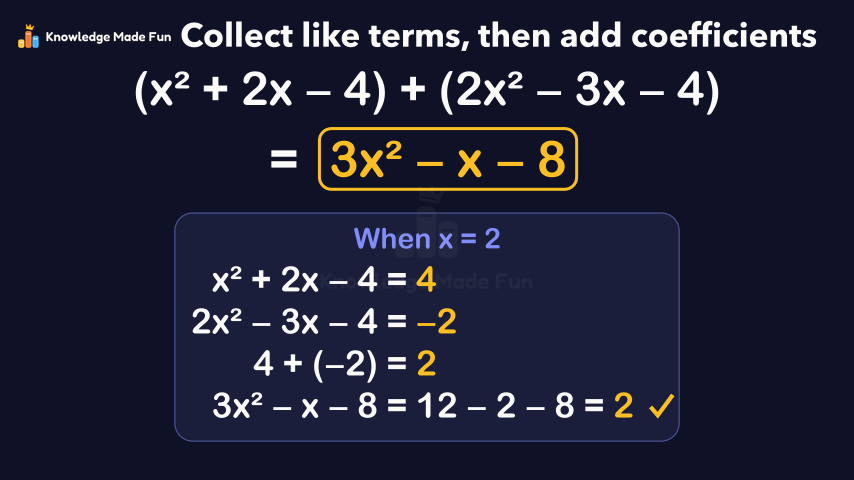 2 min
Adding Polynomials by Collecting Like Terms
Grade 9 · 2 min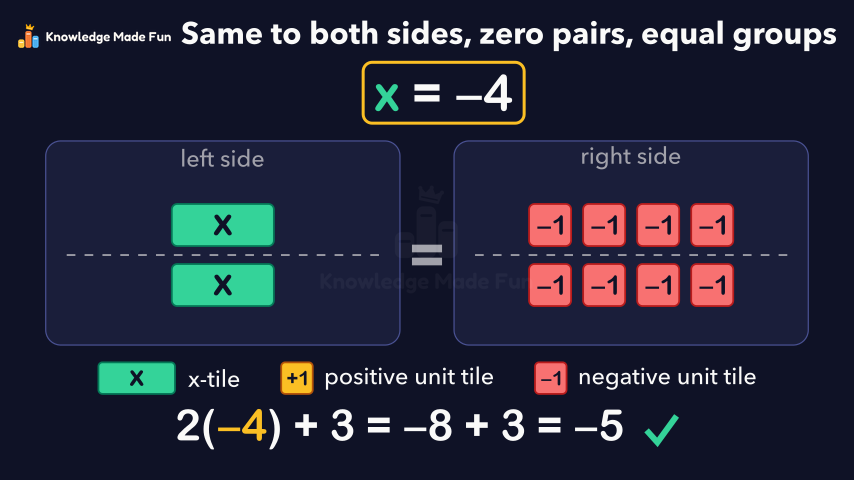 1 min 59 s
Algebra Tiles: Solving 2x + 3 = −5 with Zero Pairs
Grade 8 · 1 min 59 s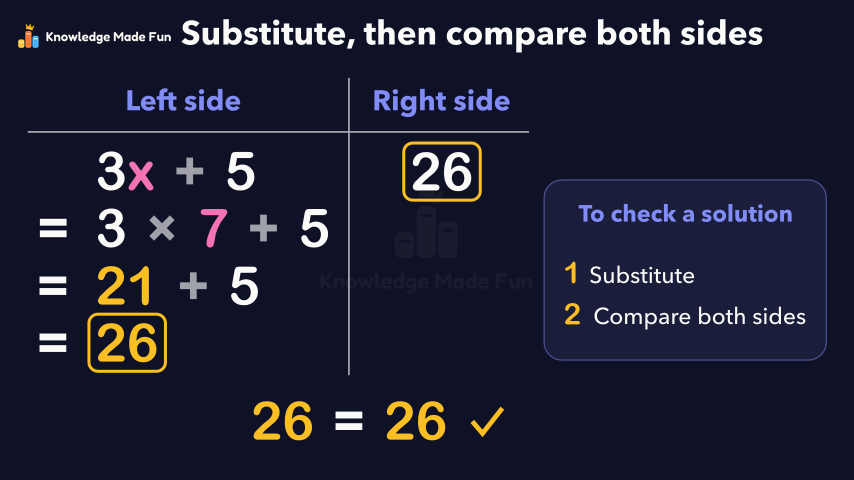 1 min 10 s
Checking a Solution by Substituting
Grade 7 · 1 min 10 s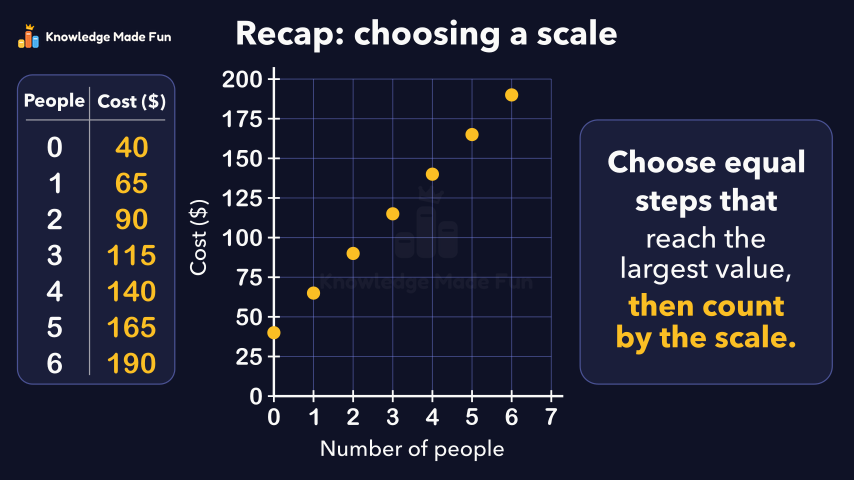 2 min 6 s
Choosing a Scale When the Numbers Are Large
Grade 8 · 2 min 6 s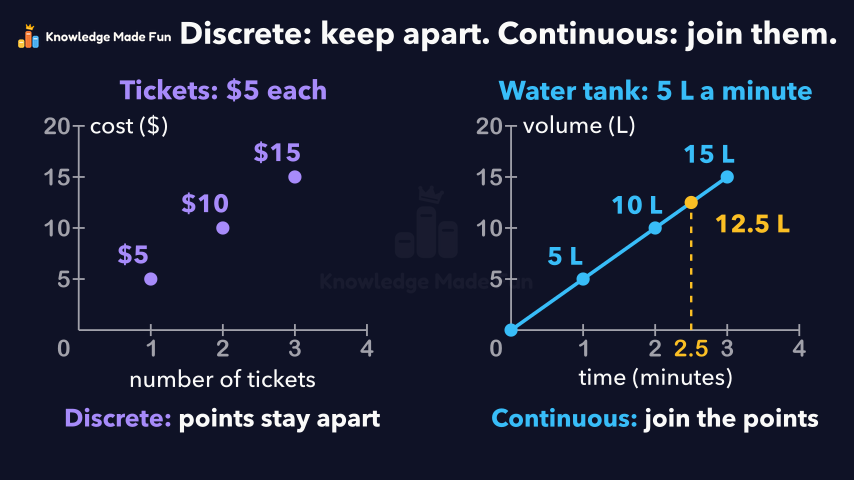 1 min 57 s
Discrete or Continuous: When to Join the Points
Grade 9 · 1 min 57 s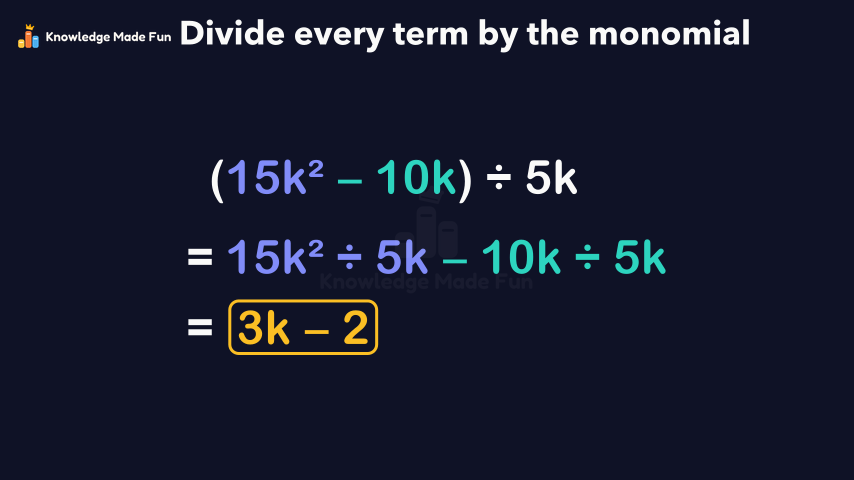 2 min 11 s
Dividing a Polynomial by a Monomial
Grade 9 · 2 min 11 s 1 min 14 s
Equal and Not Equal on a Balance
Grade 1 · 1 min 14 s
- All Grade 7 Mathematics lessons
- Teachers: the maths worksheets for Grade 7 are in the dashboard, each with a worked example and a proven answer key.
- Try the graph paper, free for everyone, no account needed.
- Create a free account to watch three lessons a day, no payment and no card.