Lesson · Grade 8 · Mathematics
Choosing a Scale When the Numbers Are Large
- Grade 8
- Mathematics
- 2 min 6 s
- British Columbia
- BC8-MA-17
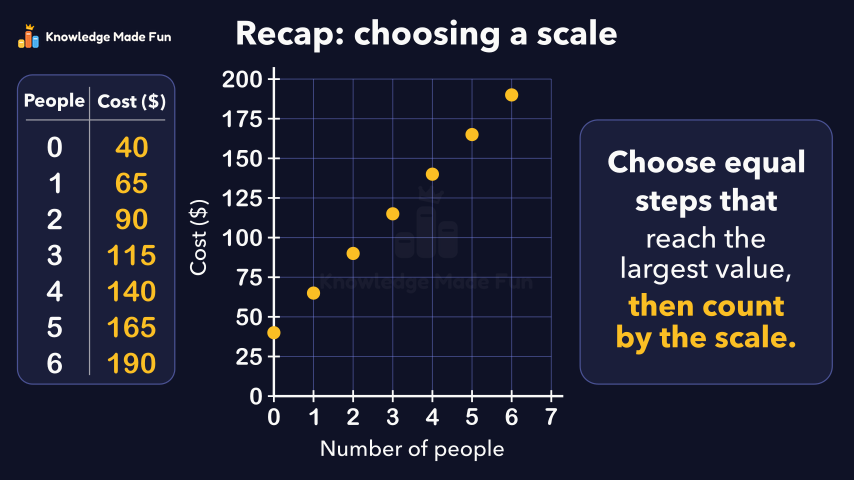
A hall that costs $40 plus $25 a person gives a table from 40 to 190 dollars for 0 to 6 people. To fit that on 8 squares, steps of 20 fall short at 160 and steps of 25 reach 200. The video warns against uneven steps like 0, 5, 10, 50, then plots the costs as separate dots by counting by the scale, since people come in whole numbers, and checks the last dot: 40 + 6 × 25 = 190.
Concept: Choosing a scale for the axes when the numbers are large
Anyone can watch two lessons on the website without an account. Signing in is free, no payment and no card, and opens three a day; Plus has no limit.
Loading
In one sentence
The question this lesson answers
A hall costs 40 dollars, plus 25 dollars a person. How do we graph the cost?
Start with a table of values. For 0 people, it is just the 40 dollar fee.
Transcript
What the lesson says
A hall costs 40 dollars, plus 25 dollars a person. How do we graph the cost?
Start with a table of values. For 0 people, it is just the 40 dollar fee.
Each person adds 25 dollars, up to 190 dollars for 6 people.
Draw two axes, the number lines of a graph: people along the bottom, cost up the side.
Tick marks are the short lines on an axis. The scale is what each step is worth.
The cost reaches 190, and the side has 8 squares. 8 steps of 20 make only 160, too low. 8 steps of 25 make 200, enough.
Label the tick marks, counting by the scale: 0, 25, 50, 75, 100, 125, 150, 175, 200.
A common mistake is uneven steps, like 0, 5, 10, 50. The jumps are 5, 5, then 40.
Every step must be equal, like ours: 25 each time.
Count by the scale, not by the squares: each square is 25 dollars, so 40 goes between 25 and 50, a bit past halfway.
Plot every other row the same way, one dot for each row.
People come in whole numbers, so we plot dots only. That makes a discrete relation: separate points with gaps.
Each person adds 25 dollars, so each dot is one square higher.
Check the last dot: 40 plus 6 times 25 is 40 plus 150, which is 190.
So choose equal steps that reach the largest value, then count by the scale.
Curriculum
Where this fits
- British Columbia, Grade 8
Mathematics, Patterns and algebra: discrete linear relations (extended to larger numbers, limited to integers)BC8-MA-17
The outcomes and strands follow the British Columbia curriculum.
Keep going
 1 min 8 s
7 and 3 More Makes 10
Grade 1 · 1 min 8 s 2 min
Adding Polynomials by Collecting Like Terms
Grade 9 · 2 min 1 min 59 s
Algebra Tiles: Solving 2x + 3 = −5 with Zero Pairs
Grade 8 · 1 min 59 s 1 min 10 s
Checking a Solution by Substituting
Grade 7 · 1 min 10 s 1 min 57 s
Discrete or Continuous: When to Join the Points
Grade 9 · 1 min 57 s 2 min 11 s
Dividing a Polynomial by a Monomial
Grade 9 · 2 min 11 s 1 min 14 s
Equal and Not Equal on a Balance
Grade 1 · 1 min 14 s 1 min 10 s
Equal and Not Equal on a Balance
Grade 2 · 1 min 10 s
- All Grade 8 Mathematics lessons
- Try the graph paper, free for everyone, no account needed.
- Create a free account to watch three lessons a day, no payment and no card.