Lesson · Grade 11 · Foundations of Mathematics
Tower of Hanoi: From Pattern to Proof
- Grade 11
- Foundations of Mathematics
- 1 min 59 s
- British Columbia
- BC11-MA-105
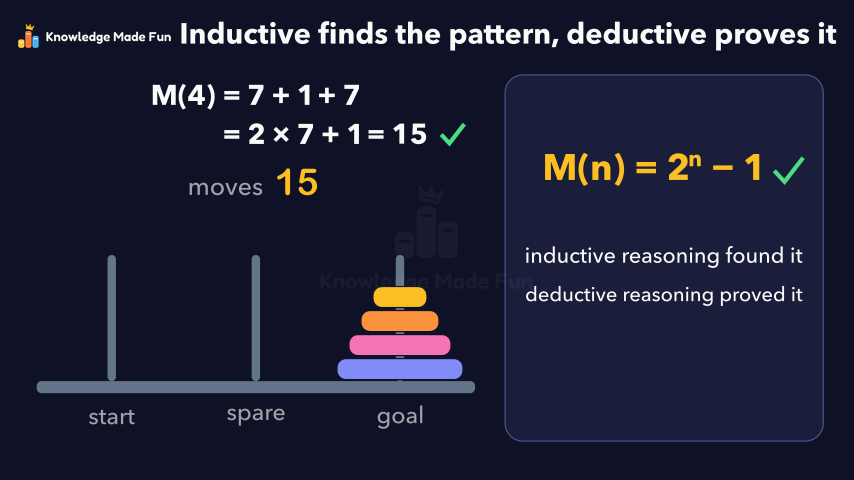
Playing the Tower of Hanoi with 1, 2, 3 and 4 discs gives 1, 3, 7 and 15 moves, which leads to the conjecture that n discs take 2ⁿ − 1 moves (inductive reasoning), with a warning that a pattern alone is not a proof. Breaking the 4-disc solution into 7 + 1 + 7 moves gives the rule M(n) = 2 × M(n − 1) + 1, which proves the formula for every n (deductive reasoning) and shows that 64 discs would take about 585 billion years.
Concept: Puzzle analysis: the Tower of Hanoi
Anyone can watch two lessons on the website without an account. Signing in is free, no payment and no card, and opens three a day; Plus has no limit.
Loading
In one sentence
The question this lesson answers
In the Tower of Hanoi, you move a stack of discs to another peg.
Move one disc at a time, and never put a larger disc on a smaller one.
Transcript
What the lesson says
In the Tower of Hanoi, you move a stack of discs to another peg.
Move one disc at a time, and never put a larger disc on a smaller one.
What is the fewest number of moves for n discs? Call it M of n.
Play it out. One disc takes 1 move.
Two discs: small aside, large across, small on top. That is 3 moves.
Three discs take 7 moves, and four discs take 15.
Add 1 to each answer: 2, 4, 8, 16. These are powers of 2.
So we conjecture, or guess without proof, that M of n is 2 to the power n, minus 1.
Going from examples to a general rule is called inductive reasoning.
The common mistake is to stop here: a pattern can work for a few cases, then fail.
Deductive reasoning goes from known facts to a conclusion that must be true.
The largest disc can only move once the 3 discs above it sit on the spare peg: 7 moves.
Then the largest disc moves, and the 3 discs go back on top: 2 times 7, plus 1, is 15.
For any n: M of n is 2 times M of n minus 1, plus 1.
Put the conjecture into this rule and it fits. M of 1 is 1 too, so the formula is proved for every n.
64 discs take 2 to the power 64, minus 1 moves: at one move a second, about 585 billion years.
Inductive reasoning found 2 to the power n, minus 1. Deductive reasoning proved it.
Curriculum
Where this fits
- British Columbia, Grade 11
Foundations of Mathematics 11, Logic and reasoning: forms of mathematical reasoningBC11-MA-105
Previous: Deductive Reasoning: Proving Odd + Odd Is Always Even
The outcomes and strands follow the British Columbia curriculum.
Keep going
 2 min 13 s
Deductive Reasoning: Proving Odd + Odd Is Always Even
Grade 11 · 2 min 13 s 2 min 15 s
Inductive reasoning: conjectures and counterexamples
Grade 11 · 2 min 15 s 2 min 11 s
Adding and Subtracting Rational Expressions
Grade 11 · 2 min 11 s 2 min 3 s
Angles in Standard Position and Reference Angles
Grade 11 · 2 min 3 s 1 min 58 s
Angles made by parallel lines and a transversal
Grade 11 · 1 min 58 s 2 min 12 s
Angles of Elevation and Depression: Measuring What You Cannot Reach
Grade 10 · 2 min 12 s 1 min 58 s
Choosing the best average: mean, median or mode
Grade 8 · 1 min 58 s 2 min 24 s
Completing the Square: From Standard Form to Vertex Form
Grade 11 · 2 min 24 s
- All Grade 11 Foundations of Mathematics lessons
- Create a free account to watch three lessons a day, no payment and no card.