Lesson · Grade 11 · Foundations of Mathematics
Deductive Reasoning: Proving Odd + Odd Is Always Even
- Grade 11
- Foundations of Mathematics
- 2 min 13 s
- British Columbia
- BC11-MA-23
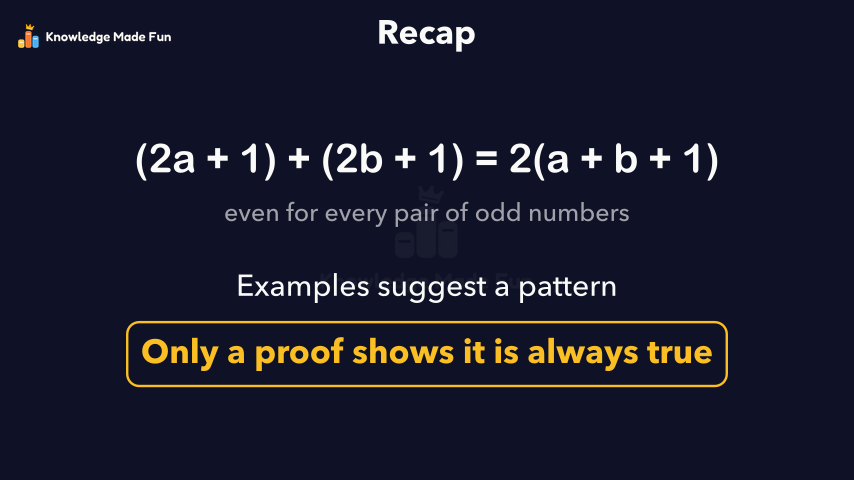
Testing 3 + 5, 7 + 9 and 11 + 15 gives even answers every time, but the video shows that a few cases can never cover every pair. It then proves the result by deductive reasoning: (2a + 1) + (2b + 1) = 2a + 2b + 2 = 2(a + b + 1), which is 2 times an integer, so the sum is always even. It checks the proof with 3 + 5 and warns that one example is not a proof. It ends with the take-1-to-3 counters game, reasoned backward to show that leaving a multiple of 4 each time wins.
Concept: Deductive reasoning: proving a statement is always true
Anyone can watch two lessons on the website without an account. Signing in is free, no payment and no card, and opens three a day; Plus has no limit.
Loading
In one sentence
The question this lesson answers
Is the sum of two odd numbers always even?
Test a few cases. 3 plus 5 is 8, 7 plus 9 is 16, and 11 plus 15 is 26.
Transcript
What the lesson says
Is the sum of two odd numbers always even?
Test a few cases. 3 plus 5 is 8, 7 plus 9 is 16, and 11 plus 15 is 26.
All even. But we can never test every pair of odd numbers.
A proof uses deductive reasoning: it goes from facts that are always true to a conclusion that must be true.
An integer is a whole number, like minus 3, 0 or 5. Even numbers are 2 times an integer.
An odd number is one more than an even number, so two odd numbers are 2a plus 1 and 2b plus 1, where a and b are integers.
Add them: the sum is 2a plus 2b plus 2.
Take out the common factor of 2: 2 times, a plus b plus 1.
Since a and b are integers, the bracket is an integer, so the sum is 2 times an integer: always even.
Check with 3 plus 5: a is 1, b is 2, and 2 times 4 is 8. It matches.
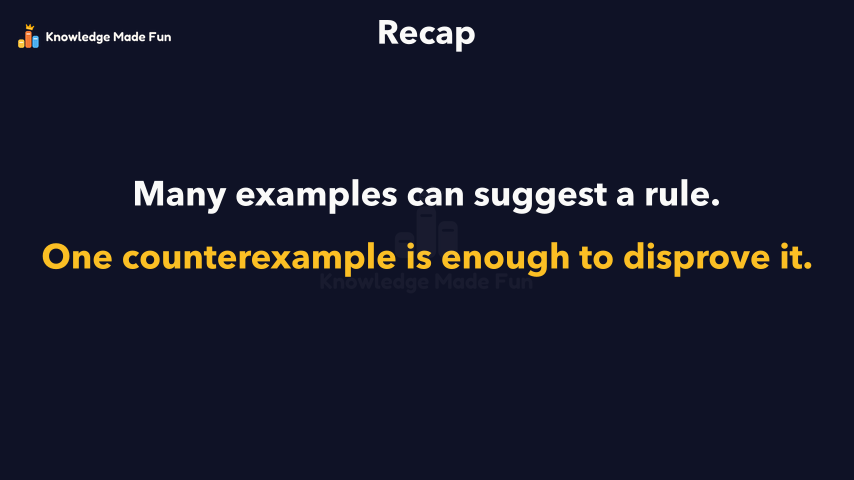
A common mistake is proving it with one example. 3 plus 5 is 8 checks only one case. A proof covers every pair of odd numbers.
A puzzle: players take turns removing 1, 2 or 3 counters. Taking the last one wins.
Reason backward from the end. Suppose you leave your opponent 4.
They take 1, you take 3. They take 2, you take 2. They take 3, you take 1.
Each round takes 4 in total, so leave 12, then 8, then 4.
12, 8 and 4 are multiples of 4. Leave one every time, and the last counter is yours.
Examples can suggest a pattern, but only a proof shows it is always true.
Curriculum
Where this fits
- British Columbia, Grade 11
Foundations of Mathematics 11, Logic and reasoning: forms of mathematical reasoningBC11-MA-23
Previous: Inductive reasoning: conjectures and counterexamplesNext: Tower of Hanoi: From Pattern to Proof
The outcomes and strands follow the British Columbia curriculum.
Keep going
 2 min 15 s
Inductive reasoning: conjectures and counterexamples
Grade 11 · 2 min 15 s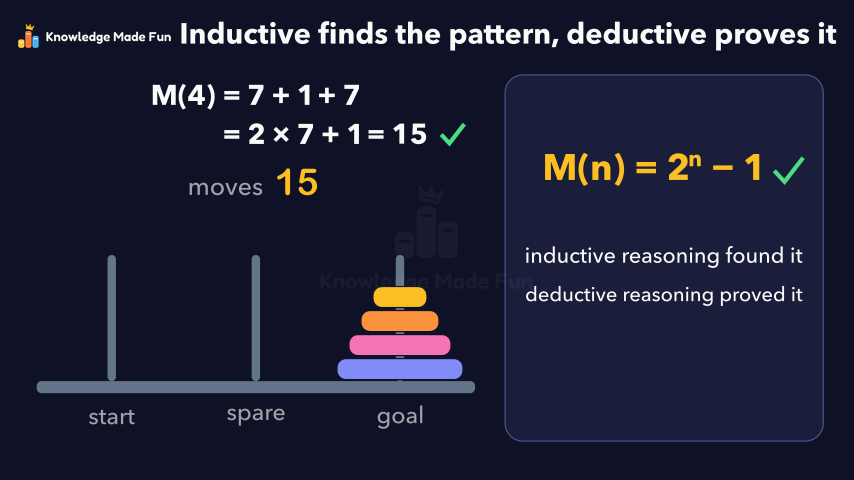 1 min 59 s
Tower of Hanoi: From Pattern to Proof
Grade 11 · 1 min 59 s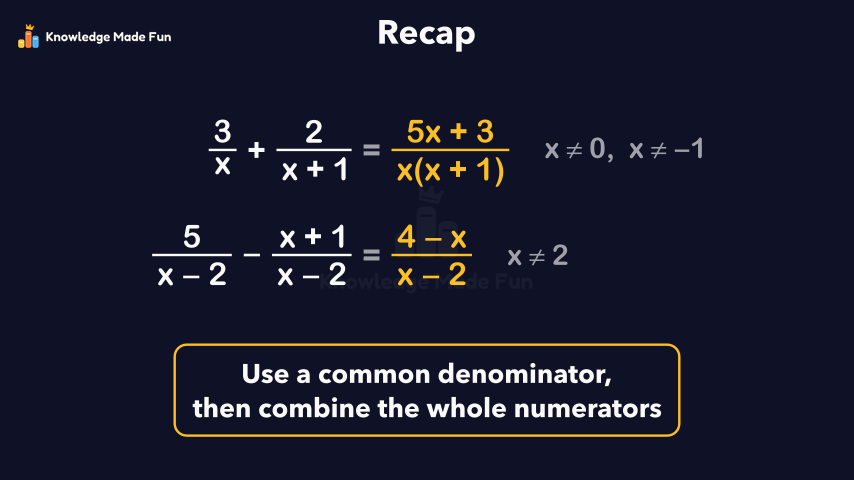 2 min 11 s
Adding and Subtracting Rational Expressions
Grade 11 · 2 min 11 s 2 min 3 s
Angles in Standard Position and Reference Angles
Grade 11 · 2 min 3 s 1 min 58 s
Angles made by parallel lines and a transversal
Grade 11 · 1 min 58 s 2 min 12 s
Angles of Elevation and Depression: Measuring What You Cannot Reach
Grade 10 · 2 min 12 s 1 min 58 s
Choosing the best average: mean, median or mode
Grade 8 · 1 min 58 s 2 min 24 s
Completing the Square: From Standard Form to Vertex Form
Grade 11 · 2 min 24 s
- All Grade 11 Foundations of Mathematics lessons
- Create a free account to watch three lessons a day, no payment and no card.