Lesson · Grade 8 · Mathematics
Perfect squares and perfect cubes: building them from tiles and cubes
- Grade 8
- Mathematics
- 2 min 23 s
- British Columbia
- BC8-MA-01
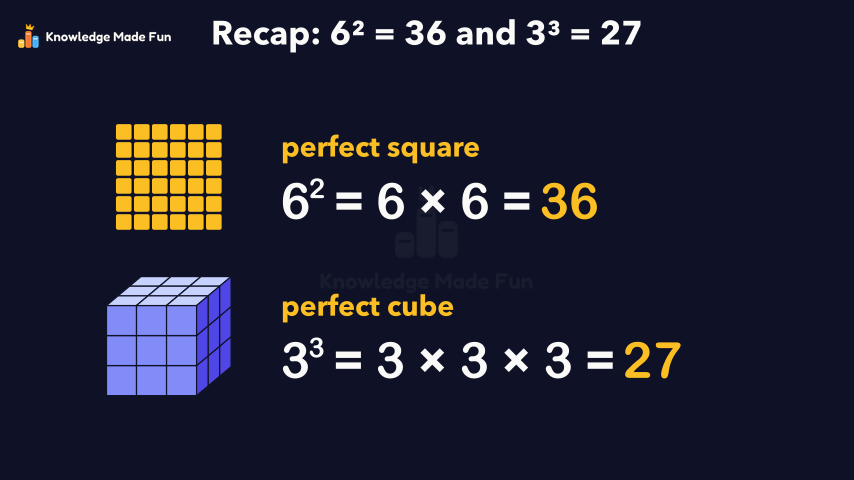
36 tiles make a 6 by 6 square, so 36 = 6², which is 6 × 6 and not the common mistake 6 × 2 = 12. 30 tiles fall between 5 × 5 and 6 × 6 and make no square, while 27 small cubes stack into a 3 by 3 by 3 cube, so 27 = 3³. The video then lists the squares of 1 to 12 and the cubes of 1 to 5 and ends on a one-line recap.
Anyone can watch two lessons on the website without an account. Signing in is free, no payment and no card, and opens three a day; Plus has no limit.
Loading
In one sentence
The question this lesson answers
Can 36 square tiles make one big square?
Yes: 6 rows of 6 tiles. Each side is 6 tiles long, and 6 times 6 is 36.
Transcript
What the lesson says
Can 36 square tiles make one big square?
Yes: 6 rows of 6 tiles. Each side is 6 tiles long, and 6 times 6 is 36.
So 36 is a perfect square: a whole number times itself.
We write 6 with a small raised 2, and say 6 squared.
The small 2 is the exponent. It tells us how many 6s are multiplied.
A common mistake is to read 6 squared as 6 times 2. That is only 12.
6 squared means 6 times 6, which is 36.
Take away 6 tiles to leave 30. Can 30 tiles make a square?
A 5 by 5 square uses 25 tiles, with 5 left over.
A 6 by 6 square needs 36. Even with the 5 spare tiles, we are 6 short.
30 is between 5 squared, 25, and 6 squared, 36, so it is not a perfect square.
Now stack 27 small cubes in 3 by 3 layers: 9, 18, 27.
The big cube is 3 long, 3 wide and 3 high, and 3 times 3 times 3 is 27.
So 27 is a perfect cube: a whole number used as a factor 3 times.
We write 3 with a small raised 3, and say 3 cubed.
Here are the squares of 1 up to 12: 1, 4, 9, 16, 25, 36, 49, 64, 81, 100, 121, 144.
And the cubes of 1 up to 5: 1, 8, 27, 64, 125.
So 6 squared, 6 times 6, is the perfect square 36, and 3 cubed, 3 times 3 times 3, is the perfect cube 27.
Curriculum
Where this fits
- British Columbia, Grade 8
Mathematics, Number: perfect squares and cubesBC8-MA-01
The outcomes and strands follow the British Columbia curriculum.
Keep going
 1 min 26 s
15.2 − 7.85
Grade 4 · 1 min 26 s 1 min 37 s
2.4 × 1.3
Grade 7 · 1 min 37 s 1 min 4 s
3 × 7 = 7 × 3: Equal Groups, Skip Counting and Arrays
Grade 4 · 1 min 4 s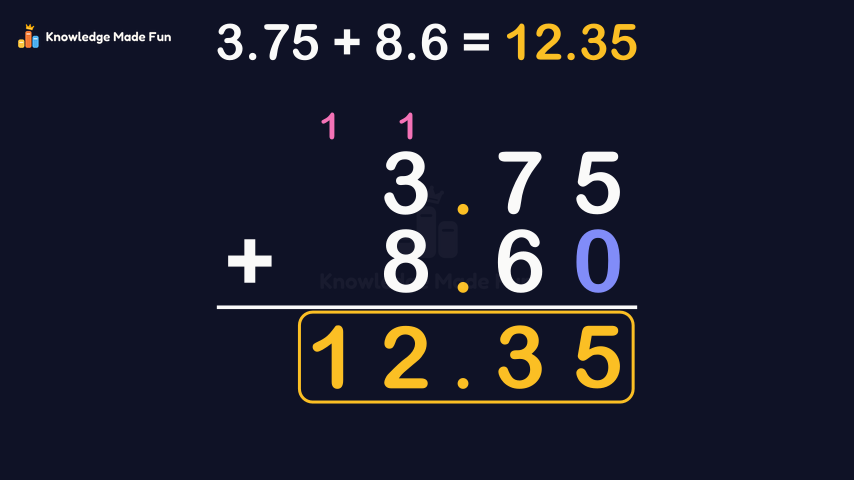 59 s
3.75 + 8.6
Grade 4 · 59 s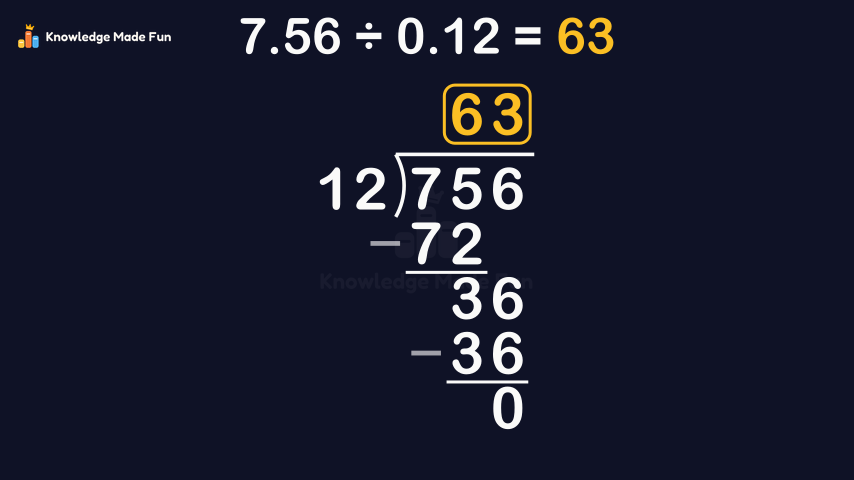 1 min 32 s
7.56 ÷ 0.12
Grade 7 · 1 min 32 s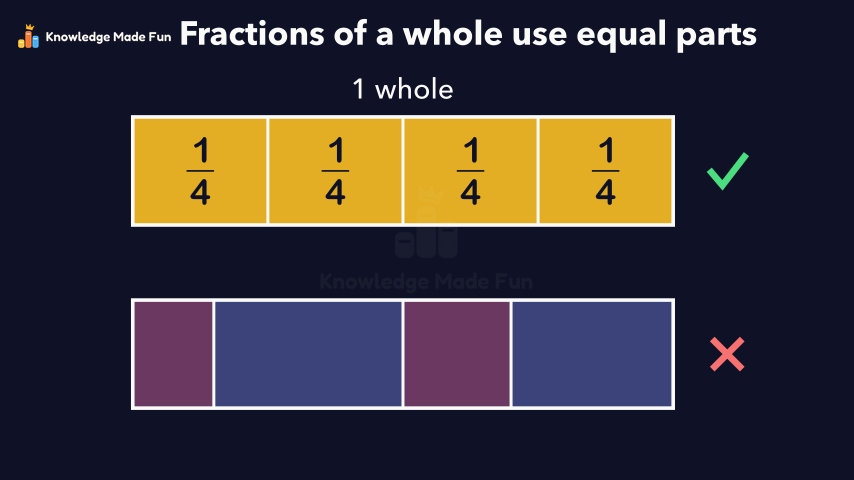 56 s
A Fraction Is Equal Parts of One Whole
Grade 3 · 56 s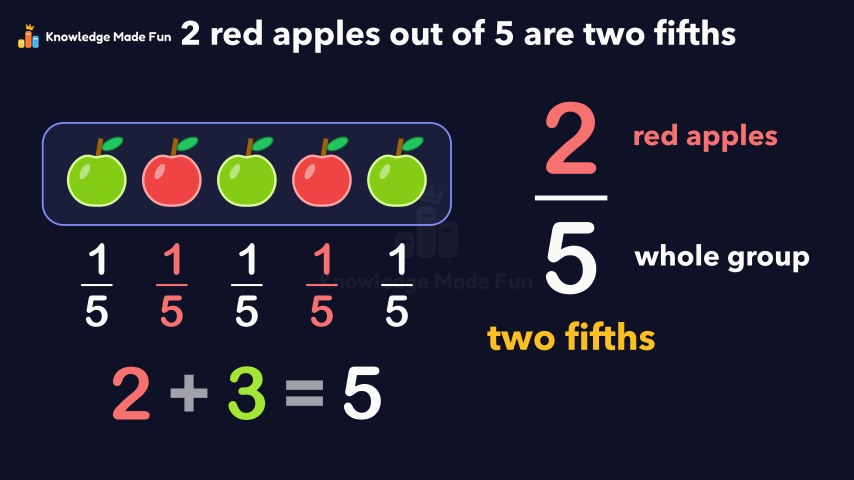 57 s
A Fraction of a Group
Grade 3 · 57 s 1 min 23 s
Adding and subtracting are related
Grade 1 · 1 min 23 s
- All Grade 8 Mathematics lessons
- Try the graph paper, free for everyone, no account needed.
- Create a free account to watch three lessons a day, no payment and no card.