Lesson · Grade 6 · English Language Arts
Formal and Informal Language
- Grade 6
- English Language Arts
- 1 min 12 s
- British Columbia
- BC6-EN-20
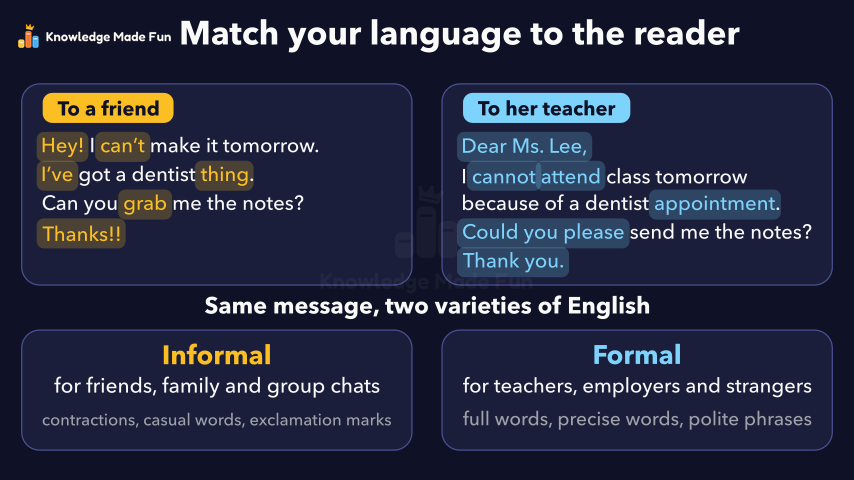
Maya tells a friend she will miss class in a relaxed message, then writes the same message to her teacher, and the two versions sit side by side so the markers of each variety light up: contractions, casual words and exclamation marks on one side, full words, precise words and a polite greeting and ending on the other. A box under each text names the variety and who it suits, and the video ends on the point that neither one is wrong, so you match your language to the reader and the situation.
Anyone can watch two lessons on the website without an account. Signing in is free, no payment and no card, and opens three a day; Plus has no limit.
Loading
In one sentence
The question this lesson answers
Formal and informal language: what is the difference?
Maya will miss class tomorrow, and she needs to tell a friend and her teacher.
Transcript
What the lesson says
Formal and informal language: what is the difference?
Maya will miss class tomorrow, and she needs to tell a friend and her teacher.
First she sends a quick message to her friend.
This is informal language, the relaxed kind we use with friends and family.
Notice the contractions, the casual words like grab and thing, and the double exclamation marks.
Now she sends the same message to her teacher.
This is formal language, the careful and polite kind for teachers, employers and strangers.
Can't becomes cannot, thing becomes appointment, and there is a polite greeting and ending.
The message stays the same, and only the variety of English changes.
So ask who will read it: friends get informal, teachers and strangers get formal.
Neither one is wrong, because each fits its own situation.
Formal or informal: match your language to the reader and the situation.
Curriculum
Where this fits
- British Columbia, Grade 6
English Language Arts, Language features, structures, and conventions: language varietiesBC6-EN-20
Previous: What Makes a Good ParagraphNext: Canadian and American Spelling: Two Ways, Both Correct
- British Columbia, Grade 7
English Language Arts, Language features, structures, and conventions: language varietiesBC7-EN-23
Previous: What Makes a Good ParagraphNext: Canadian and American Spelling: Two Ways, Both Correct
This lesson is also listed in Grade 7.
The outcomes and strands follow the British Columbia curriculum.
Keep going
 42 s
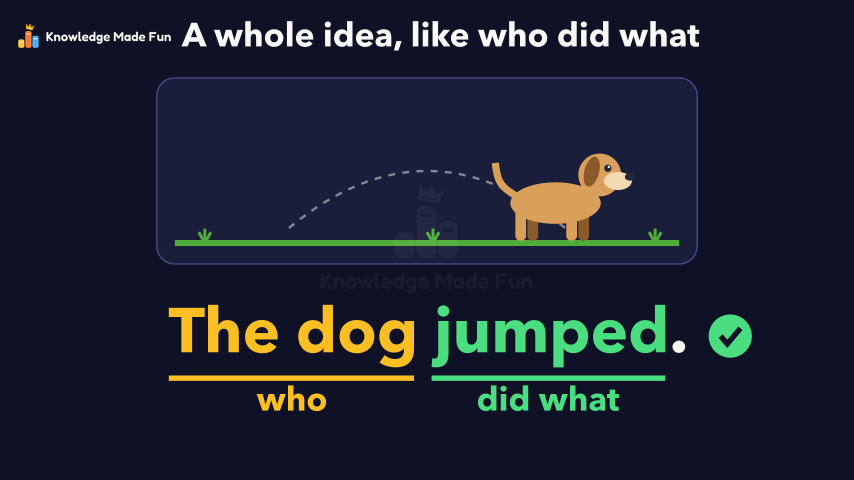
A Sentence Tells a Whole Idea: Who Did What
Grade 1 · 42 s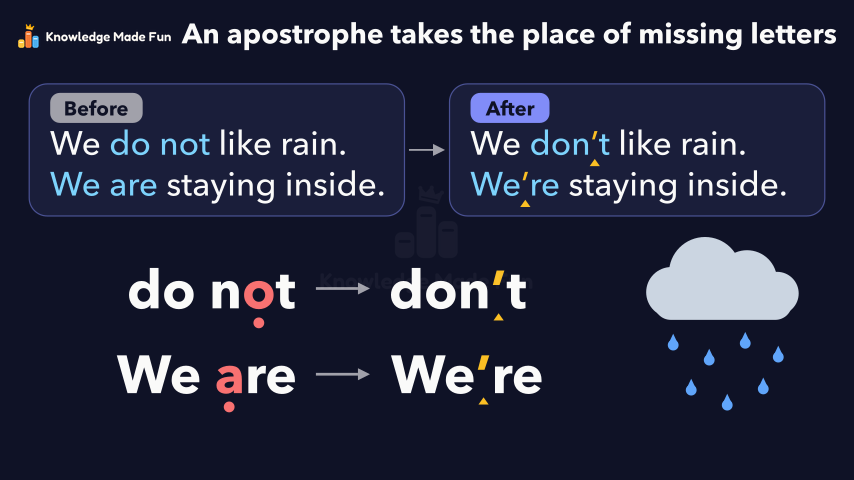 1 min 1 s
Apostrophes in Contractions: Do Not Becomes Don't
Grade 3 · 1 min 1 s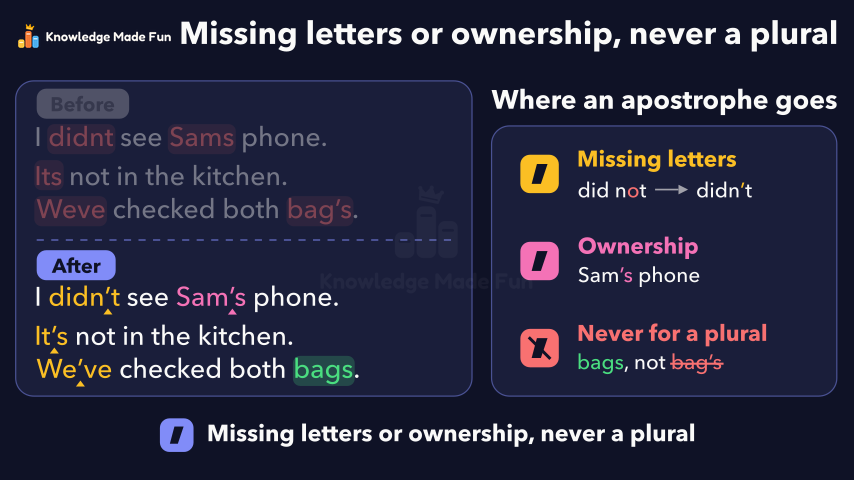 1 min 45 s
Apostrophes: Missing Letters or Ownership, Never a Plural
Grade 4 · 1 min 45 s 54 s
Blending and Splitting Sounds: c, a, t Makes cat
Grade 1 · 54 s 54 s
Blending Sounds: c, a, t Makes cat
Kindergarten · 54 s 1 min 5 s
Canadian and American Spelling: Two Ways, Both Correct
Grade 5 · 1 min 5 s 53 s
Capital Letters and End Marks
Grade 2 · 53 s 1 min 12 s
Capital Letters in Titles and Headings
Grade 5 · 1 min 12 s
- All Grade 6 English Language Arts lessons
- Create a free account to watch three lessons a day, no payment and no card.