Lesson · Grade 6 · English Language Arts
Capital Letters: Sentences, Names and the Word I
- Grade 6
- English Language Arts
- 1 min 26 s
- British Columbia
- BC6-EN-32
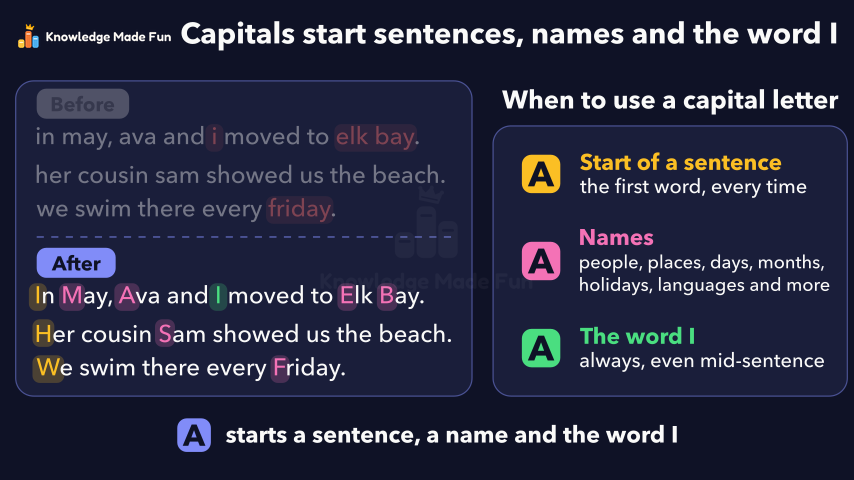
A three-sentence note typed all in lower case sits on a card, and the words that mislead without capitals (i, elk bay, friday) are marked in red while a box on the right builds up the three jobs of a capital letter: the first word of a sentence, a name (people, places, days and months) and the word I. The same note then appears with its capitals in place, each one lit in the colour of its job, and the video ends on the one-line recap that a capital letter starts a sentence, a name and the word I.
Concept: Capital letters
Anyone can watch two lessons on the website without an account. Signing in is free, no payment and no card, and opens three a day; Plus has no limit.
Loading
In one sentence
The question this lesson answers
When does a word need a capital letter?
Here is a short note about a new home, typed with no capital letters at all.
Transcript
What the lesson says
When does a word need a capital letter?
Here is a short note about a new home, typed with no capital letters at all.
Without capitals, nothing stands out. The word i looks like a typo, and names like elk bay and friday look like ordinary words.
A capital letter is a signpost for the reader. It has three main jobs.
First, every sentence starts with a capital letter.
Second, a name starts with a capital: a person, a place, a day or a month, and other names like holidays and languages.
Third, the word I is always a capital, even in the middle of a sentence.
Here is the same note with its capital letters in place.
In, Her and We each begin a sentence, so each one starts with a capital letter.
May, Ava, Elk Bay, Sam and Friday are all names, so each one starts with a capital. Elk Bay gets two, one for each word.
And I is a capital on its own, even in the middle of the sentence.
Now the reader can see at a glance where each sentence begins and which words are names.
A capital letter starts every sentence, every name and the word I.
Curriculum
Where this fits
- British Columbia, Grade 6
English Language Arts, Language features, structures, and conventions: conventionsBC6-EN-32
- British Columbia, Grade 7
English Language Arts, Language features, structures, and conventions: conventionsBC7-EN-36
This lesson is also listed in Grade 7.
The outcomes and strands follow the British Columbia curriculum.
Keep going
 42 s
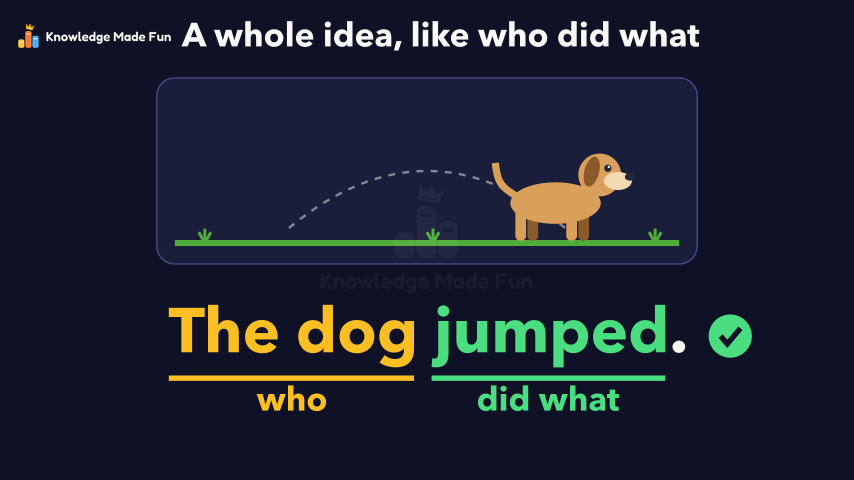
A Sentence Tells a Whole Idea: Who Did What
Grade 1 · 42 s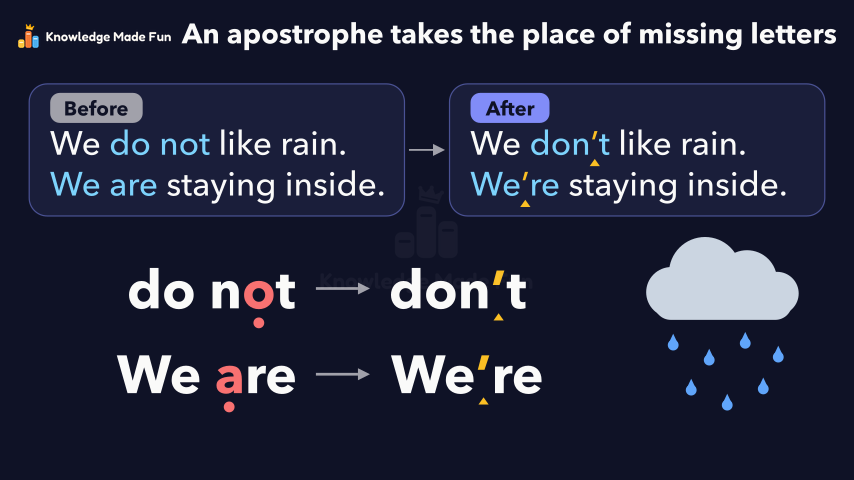 1 min 1 s
Apostrophes in Contractions: Do Not Becomes Don't
Grade 3 · 1 min 1 s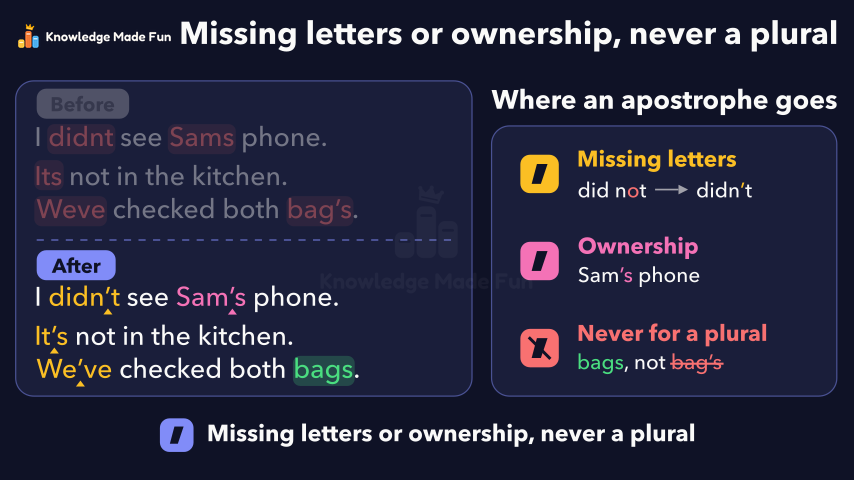 1 min 45 s
Apostrophes: Missing Letters or Ownership, Never a Plural
Grade 4 · 1 min 45 s 54 s
Blending and Splitting Sounds: c, a, t Makes cat
Grade 1 · 54 s 54 s
Blending Sounds: c, a, t Makes cat
Kindergarten · 54 s 1 min 5 s
Canadian and American Spelling: Two Ways, Both Correct
Grade 5 · 1 min 5 s 53 s
Capital Letters and End Marks
Grade 2 · 53 s 1 min 12 s
Capital Letters in Titles and Headings
Grade 5 · 1 min 12 s
- All Grade 6 English Language Arts lessons
- Create a free account to watch three lessons a day, no payment and no card.