Lesson · Grade 3 · Arts Education
Pitch, Dynamics and Timbre: How High, How Loud, What Kind of Sound
- Grade 3
- Arts Education
- 1 min 25 s
- British Columbia
- BC3-AR-04
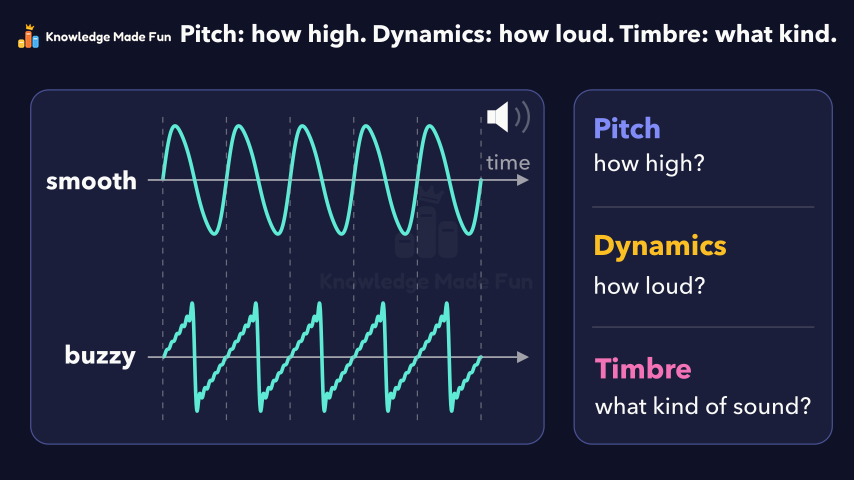
A card asks three questions about a note (how high, how loud, what kind of sound) and names them pitch, dynamics and timbre. Beside it a note is drawn as a wave over time, and a short tone plays for each example: lower and higher notes with waves farther apart or closer together, soft and loud notes with small or big waves marked p and f, and a smooth and a buzzy note with the same pitch and loudness but differently shaped waves, ending on a one-line recap.
Anyone can watch two lessons on the website without an account. Signing in is free, no payment and no card, and opens three a day; Plus has no limit.
Loading
In one sentence
The question this lesson answers
Ask three questions about a note: how high, how loud, and what kind of sound?
Musicians call these pitch, dynamics and timbre.
Transcript
What the lesson says
Ask three questions about a note: how high, how loud, and what kind of sound?
Musicians call these pitch, dynamics and timbre.
A note is a vibration, and we can draw it as a wave over time.
Pitch is how high or low a note sounds.
A lower note vibrates more slowly, so its waves are farther apart.
A higher note vibrates faster, so its waves are closer together.
Dynamics means how loud or soft the music is.
A soft sound has small waves and is marked p, for piano, meaning soft.
A loud sound has big waves and is marked f, for forte, meaning loud.
Timbre is the kind of sound, also called tone colour.
This note sounds smooth, and its wave has rounded curves.
This one sounds buzzy, with the same pitch and the same loudness.
Its wave has a different shape, so it has a different timbre.
Pitch is how high, dynamics is how loud, and timbre is what kind of sound.
Curriculum
Where this fits
- British Columbia, Grade 3
Arts Education, Music: music: beat/pulse, duration, rhythm (music), tempo, pitch, timbre, dynamics (music), form textureBC3-AR-04
Previous: Beat, Rhythm and TempoNext: Writing Sounds Down: High and Low on a Staff
- British Columbia, Grade 4
Arts Education, Music: music: beat/pulse, duration, rhythm (music), tempo, pitch, timbre, dynamics (music), form (music), textureBC4-AR-04
Previous: Beat, Rhythm and TempoNext: Reading Music: The Staff, Notes and Rests
- British Columbia, Grade 5
Arts Education, Music: music: beat/pulse, metre, duration, rhythm (music), tempo, pitch, timbre, dynamics (music), form (music), textureBC5-AR-04
Previous: Beat, metre and rhythm: how music moves in timeNext: Reading Music: The Staff, Notes and Rests
- British Columbia, Grade 6
Arts Education, Music: music: beat/pulse, metre, duration, rhythm (music), tempo, pitch, timbre, dynamics (music), form (music), textureBC6-AR-02
Previous: Beat, metre and rhythm: how music moves in timeNext: Reading Music: The Staff, Notes and Rests
- British Columbia, Grade 7
Arts Education, Music: music: beat/pulse, metre, duration, rhythm (music), tempo, pitch, timbre, dynamics (music), form (music), texture, notationBC7-AR-04
Previous: Beat, metre and rhythm: how music moves in timeNext: Reading Music: The Staff, Notes and Rests
This lesson is also listed in Grade 4, Grade 5, Grade 6 and Grade 7.
The outcomes and strands follow the British Columbia curriculum.
Keep going
 1 min 13 s
Beat and Rhythm
Grade 2 · 1 min 13 s 1 min 6 s
Beat and Rhythm: The Steady Pulse and the Pattern on Top
Grade 1 · 1 min 6 s 1 min 25 s
Beat, metre and rhythm: how music moves in time
Grade 5 · 1 min 25 s 1 min 21 s
Beat, Rhythm and Tempo
Grade 3 · 1 min 21 s 1 min 3 s
Drawing Sounds: Long, Short, Loud and Soft
Grade 1 · 1 min 3 s 1 min 12 s
Fast or Slow, Loud or Soft: Tempo and Dynamics
Grade 1 · 1 min 12 s 1 min 6 s
High and Low Sounds
Grade 2 · 1 min 6 s 1 min 14 s
High or Low, Loud or Soft
Kindergarten · 1 min 14 s
- All Grade 3 Arts Education lessons
- Create a free account to watch three lessons a day, no payment and no card.