Lesson · Grade 11 · Chemistry
Significant Figures: How Precise Is Your Answer?
- Grade 11
- Chemistry
- 1 min 53 s
- British Columbia
- BC11-SC-22
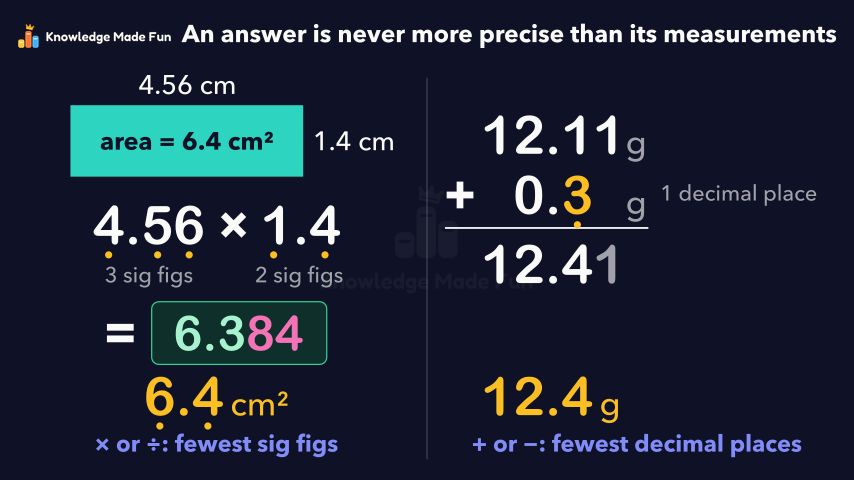
A paper strip measured on a millimetre ruler reads 4.56 cm: the 4 and the 5 are certain and the 6 is estimated by eye, which explains what significant figures are, and four rules for counting them follow (non-zero digits, zeros between them, leading zeros, trailing zeros after a decimal point). The strip's area, 4.56 cm × 1.4 cm, shows that the calculator's 6.384 must be cut to the fewest significant figures (6.4 cm²), and 12.11 g + 0.3 g shows that adding keeps the fewest decimal places (12.4 g), ending on the recap that an answer is never more precise than its measurements.
Concept: Significant figures in measurements and calculations
Anyone can watch two lessons on the website without an account. Signing in is free, no payment and no card, and opens three a day; Plus has no limit.
Loading
In one sentence
The question this lesson answers
A calculator gives you an answer like 6.384. Should you keep every digit?
Start with a measurement. This ruler has millimetre marks.
Transcript
What the lesson says
A calculator gives you an answer like 6.384. Should you keep every digit?
Start with a measurement. This ruler has millimetre marks.
Zoom in. The end is past 4.5 centimetres, but not at 4.6.
So we estimate one more digit by eye: 4.56 centimetres.
The 4 and the 5 are certain. The 6 is an estimate.
These are the significant figures, or sig figs. 4.56 has three.
Non-zero digits count, and so do zeros between them: 2.05 has three.
Leading zeros never count. They only place the decimal point: 0.045 has two.
Trailing zeros count after a decimal point: 3.40 has three.
Back to the strip: it is 1.4 centimetres wide. A calculator gives its area as 6.384 square centimetres.
But a long calculator answer is no more precise than the measurements.
For multiplying or dividing, keep the fewest sig figs: 4.56 has three, 1.4 has two.
So the area is 6.4 square centimetres.
Now add 12.11 grams and 0.3 grams. The calculator says 12.41.
For adding or subtracting, keep the fewest decimal places: one here, so 12.4 grams.
An answer is never more precise than the measurements it comes from.
Curriculum
Where this fits
- British Columbia, Grade 11
Chemistry 11, The mole and stoichiometry: dimensional analysisBC11-SC-22
Previous: The factor-label method: let the units guide youNext: Grams to Moles to Particles
The outcomes and strands follow the British Columbia curriculum.
Keep going
 2 min 20 s
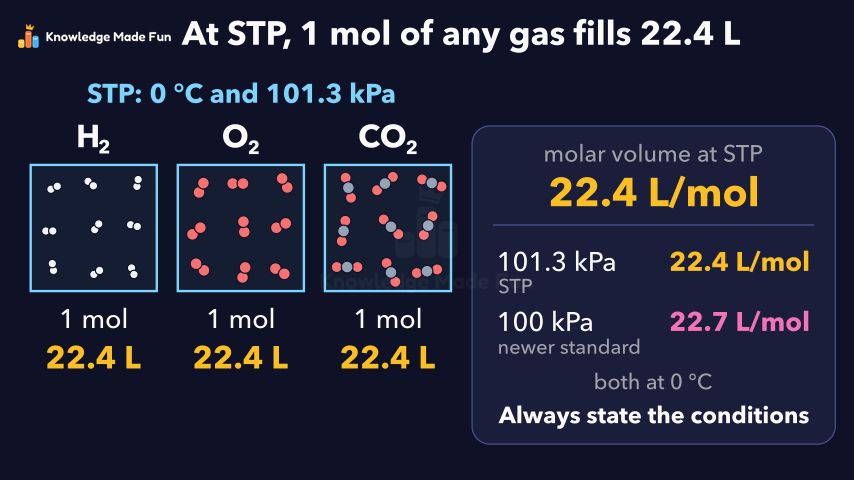
Gas volumes: one mole of any gas at STP
Grade 11 · 2 min 20 s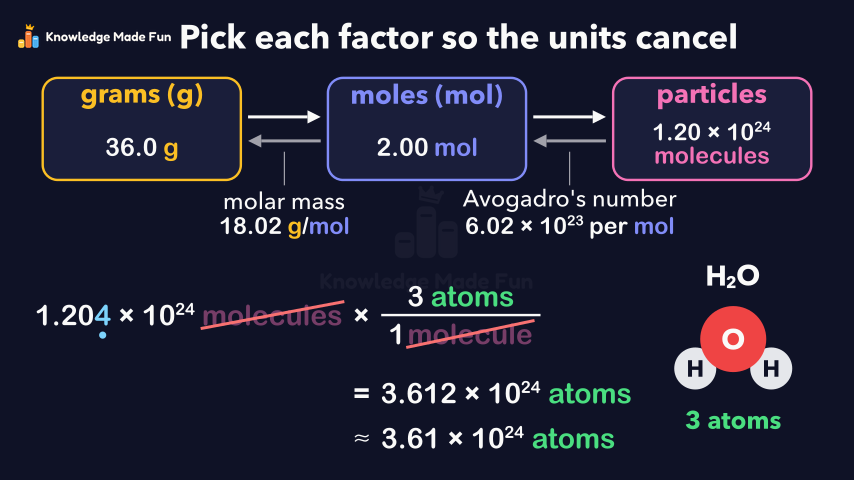 1 min 57 s
Grams to Moles to Particles
Grade 11 · 1 min 57 s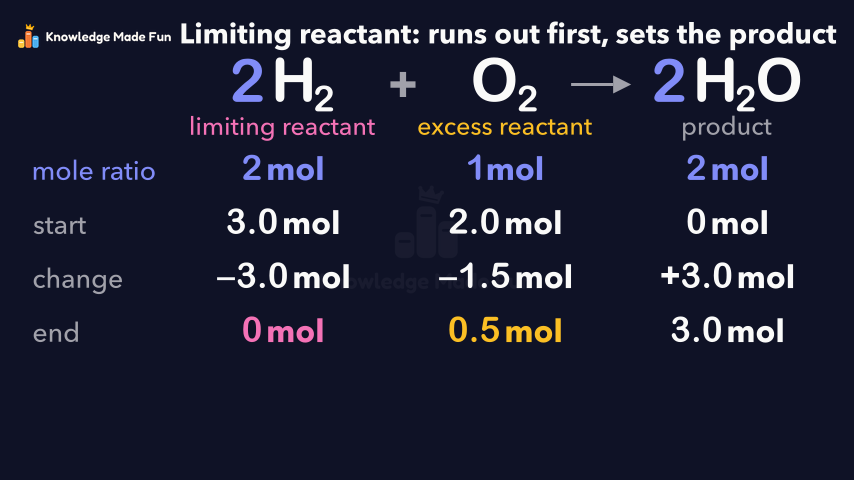 1 min 58 s
Limiting and Excess Reactants
Grade 11 · 1 min 58 s 2 min 15 s
Molar mass: adding up atomic masses
Grade 11 · 2 min 15 s 2 min 1 s
Stoichiometry: Using Mole Ratios to Predict Amounts
Grade 11 · 2 min 1 s 2 min
The factor-label method: let the units guide you
Grade 11 · 2 min 2 min 6 s
The mole: counting particles by weighing
Grade 11 · 2 min 6 s 1 min 40 s
Acids and bases: the pH scale
Grade 10 · 1 min 40 s
- All Grade 11 Chemistry lessons
- Create a free account to watch three lessons a day, no payment and no card.