Lesson · Grade 11 · Chemistry
Gas volumes: one mole of any gas at STP
- Grade 11
- Chemistry
- 2 min 20 s
- British Columbia
- BC11-SC-28
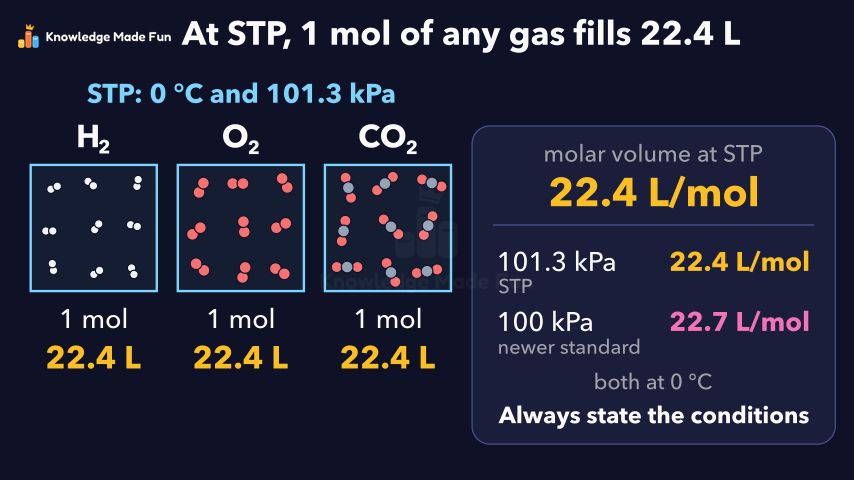
Three equal boxes each hold one mole of hydrogen, oxygen and carbon dioxide at 0 °C and 101.3 kPa: each fills 22.4 L, because gas particles are so far apart that each one's share of space is far bigger than the particle, so molecule size hardly matters. The molar volume is then used to turn 11.2 L of oxygen into 0.500 mol (to three significant figures) and 3.00 mol of carbon dioxide into 67.2 L, to show that 1 L of oxygen reacts with 2 L of hydrogen, and to compare the newer standard of 100 kPa, where the value is 22.7 L.
Anyone can watch two lessons on the website without an account. Signing in is free, no payment and no card, and opens three a day; Plus has no limit.
Loading
In one sentence
The question this lesson answers
Hydrogen, oxygen and carbon dioxide have bigger and bigger molecules.
Take one mole of each. A mole is a set number of particles: 6.02 times 10 to the power of 23.
Transcript
What the lesson says
Hydrogen, oxygen and carbon dioxide have bigger and bigger molecules.
Take one mole of each. A mole is a set number of particles: 6.02 times 10 to the power of 23.
Do the bigger molecules need more space?
We compare them at STP, standard temperature and pressure: 0 degrees Celsius and 101.3 kilopascals.
At STP, one mole of hydrogen, oxygen or carbon dioxide fills the same 22.4 litres.
The volume of one mole of a gas is its molar volume: 22.4 litres per mole at STP.
Gas particles are far apart, so each one's share of space is far bigger than the particle itself.
So molecule size hardly matters: big or small, a mole takes almost exactly the same volume.
To change a gas volume at STP into moles, divide by 22.4 litres per mole.
So 11.2 litres of oxygen is 11.2 divided by 22.4, which is 0.500 moles: half of the box.
11.2 has three significant figures, the digits that show how precise it is, so the answer keeps three: 0.500, not 0.5.
Going the other way, 3.00 moles of carbon dioxide fills 3.00 times 22.4, which is 67.2 litres.
When hydrogen burns, 2 moles of hydrogen react with 1 mole of oxygen to make water.
At the same temperature and pressure, equal volumes of gas hold equal moles, so 1 litre of oxygen reacts with 2 litres of hydrogen.
Always state the conditions: at the newer standard of 0 degrees Celsius and 100 kilopascals, one mole fills 22.7 litres.
At STP, one mole of any gas fills 22.4 litres, whatever the size of its molecules.
Curriculum
Where this fits
- British Columbia, Grade 11
Chemistry 11, The mole and stoichiometry: stoichiometric calculations using significant figuresBC11-SC-28
Previous: Stoichiometry: Using Mole Ratios to Predict AmountsNext: Limiting and Excess Reactants
The outcomes and strands follow the British Columbia curriculum.
Keep going
 1 min 57 s
Grams to Moles to Particles
Grade 11 · 1 min 57 s 1 min 58 s
Limiting and Excess Reactants
Grade 11 · 1 min 58 s 2 min 15 s
Molar mass: adding up atomic masses
Grade 11 · 2 min 15 s 1 min 53 s
Significant Figures: How Precise Is Your Answer?
Grade 11 · 1 min 53 s 2 min 1 s
Stoichiometry: Using Mole Ratios to Predict Amounts
Grade 11 · 2 min 1 s 2 min
The factor-label method: let the units guide you
Grade 11 · 2 min 2 min 6 s
The mole: counting particles by weighing
Grade 11 · 2 min 6 s 1 min 40 s
Acids and bases: the pH scale
Grade 10 · 1 min 40 s
- All Grade 11 Chemistry lessons
- Create a free account to watch three lessons a day, no payment and no card.