Lesson · Grade 11 · Chemistry
Hydrogen Bonds: Why Water Boils at 100 °C
- Grade 11
- Chemistry
- 1 min 56 s
- British Columbia
- BC11-SC-11
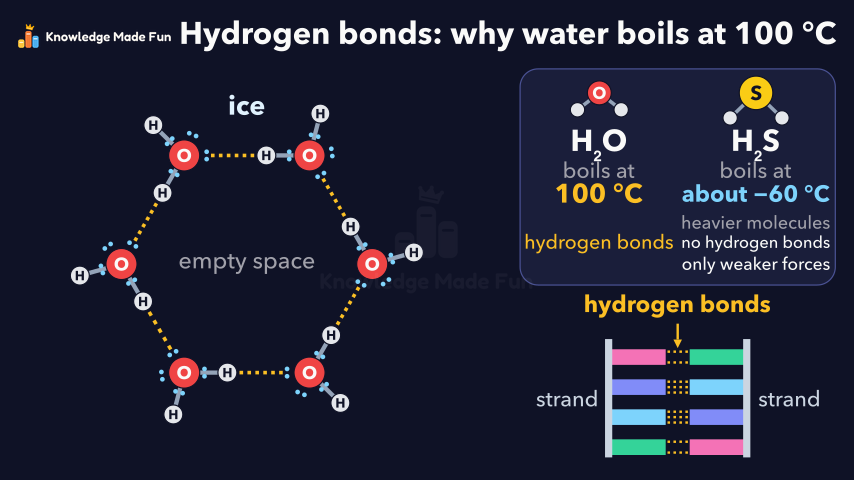
A labelled diagram of water molecules builds up from covalent bonds, partial charges and lone pairs to the hydrogen bond between molecules. It explains why water boils at 100 °C while heavier H₂S boils at about −60 °C. The same molecules then form the open hexagon in ice, which makes ice less dense so it floats, and the video ends with hydrogen bonds holding DNA's two strands together.
Anyone can watch two lessons on the website without an account. Signing in is free, no payment and no card, and opens three a day; Plus has no limit.
Loading
In one sentence
The question this lesson answers
Why does water boil at 100 degrees Celsius, when heavier H2S molecules boil at about minus 60?
Inside water, oxygen shares an electron pair with each hydrogen: each shared pair is a covalent bond.
Transcript
What the lesson says
Why does water boil at 100 degrees Celsius, when heavier H2S molecules boil at about minus 60?
Inside water, oxygen shares an electron pair with each hydrogen: each shared pair is a covalent bond.
Oxygen is very electronegative: it pulls the shared electrons toward itself.
So oxygen is slightly negative, delta minus, and each hydrogen slightly positive, delta plus.
Oxygen also has two lone pairs: outer electron pairs not used in bonding.
The delta plus hydrogen of a second molecule is attracted to this lone pair: a hydrogen bond.
It needs a hydrogen bonded to nitrogen, oxygen or fluorine, and a lone pair on a nearby nitrogen, oxygen or fluorine.
A hydrogen bond is not a covalent bond inside a molecule. It is a weaker attraction between molecules.
In liquid water, each molecule makes hydrogen bonds with its neighbours.
Boiling must break these hydrogen bonds. That takes a lot of energy, so water boils at 100 degrees Celsius.
The covalent bonds do not break: steam is still H2O.
Sulfur is not electronegative enough for hydrogen bonds, so only weaker forces hold H2S molecules together.
In ice, hydrogen bonds hold the molecules in an open pattern of hexagons.
This open pattern leaves empty space, so ice is less dense than liquid water and floats.
Hydrogen bonds also hold the two strands of DNA together.
Hydrogen bonds between water molecules are why water boils at 100 degrees Celsius.
Curriculum
Where this fits
- British Columbia, Grade 11
Chemistry 11, Bonding: bonds/forcesBC11-SC-11
Previous: Dispersion and Dipole Forces: Why Some Substances Boil Higher
The outcomes and strands follow the British Columbia curriculum.
Keep going
 1 min 58 s
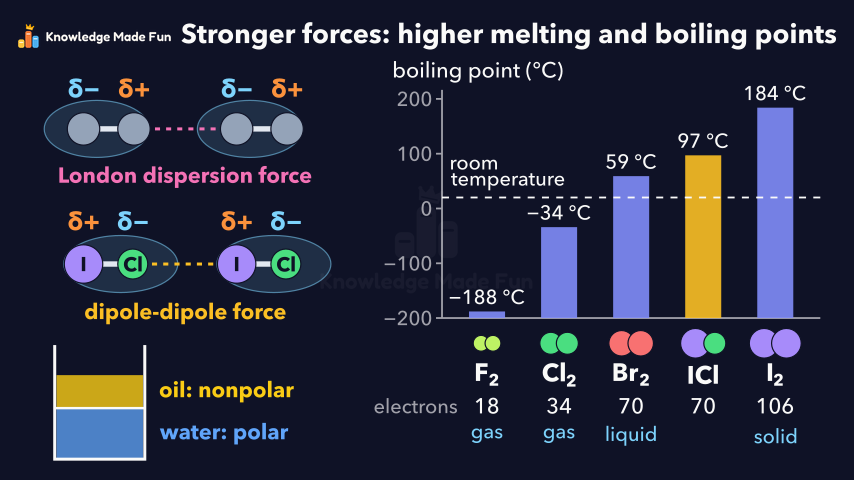
Dispersion and Dipole Forces: Why Some Substances Boil Higher
Grade 11 · 1 min 58 s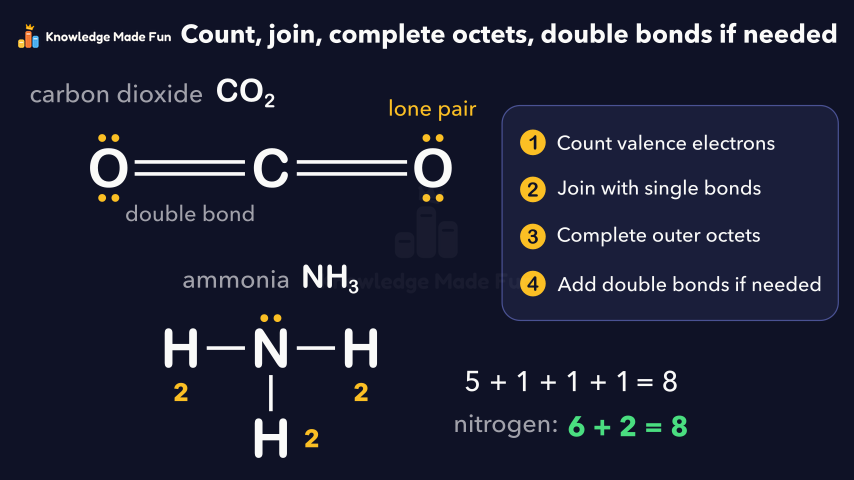 2 min 3 s
Drawing Lewis structures step by step
Grade 11 · 2 min 3 s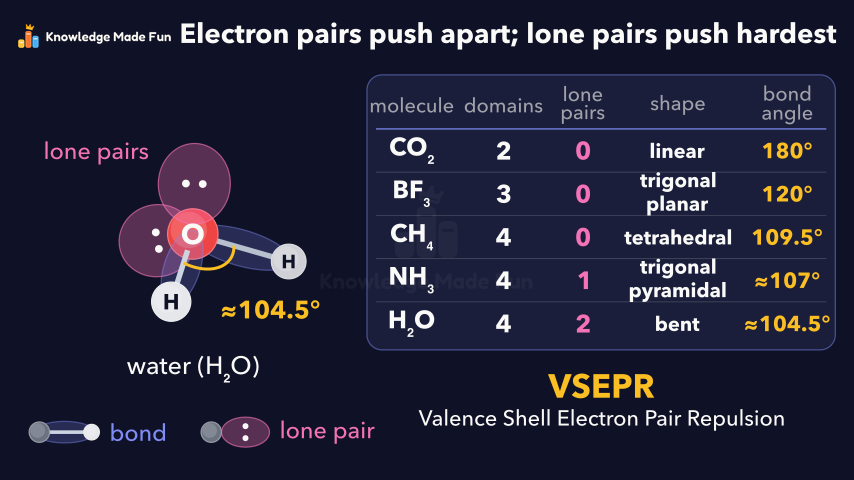 1 min 55 s
Electron Pairs Push Apart: VSEPR Molecule Shapes
Grade 11 · 1 min 55 s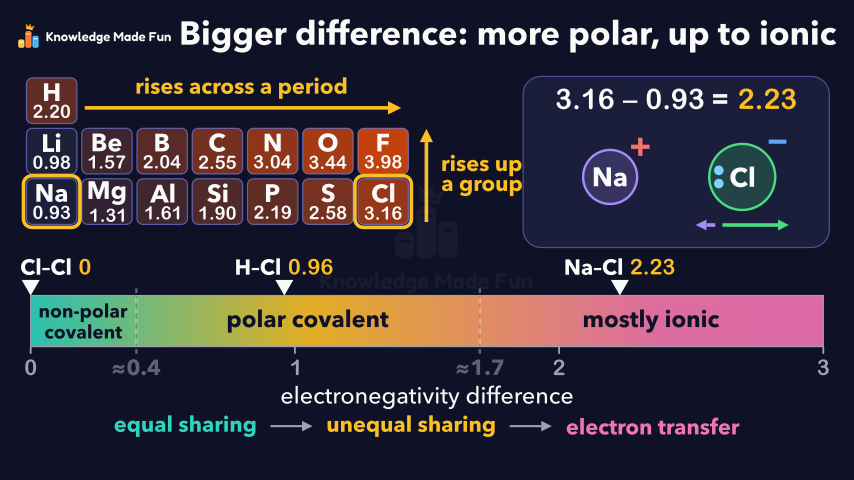 1 min 58 s
Electronegativity difference decides the bond type
Grade 11 · 1 min 58 s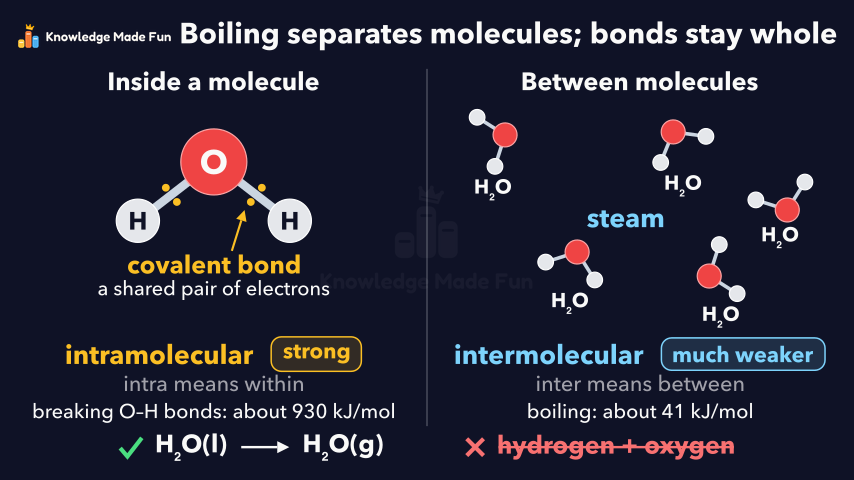 1 min 40 s
Forces Inside Molecules vs Forces Between Molecules
Grade 11 · 1 min 40 s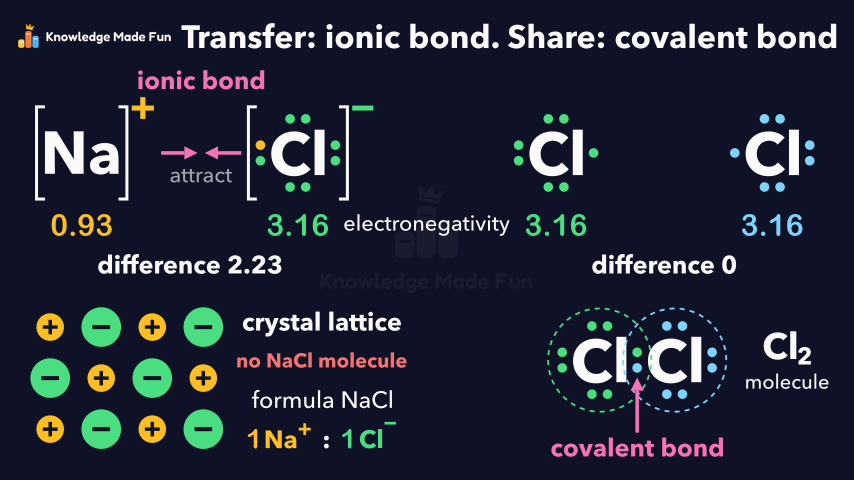 1 min 56 s
Ionic and Covalent Bonds: Transfer or Share?
Grade 11 · 1 min 56 s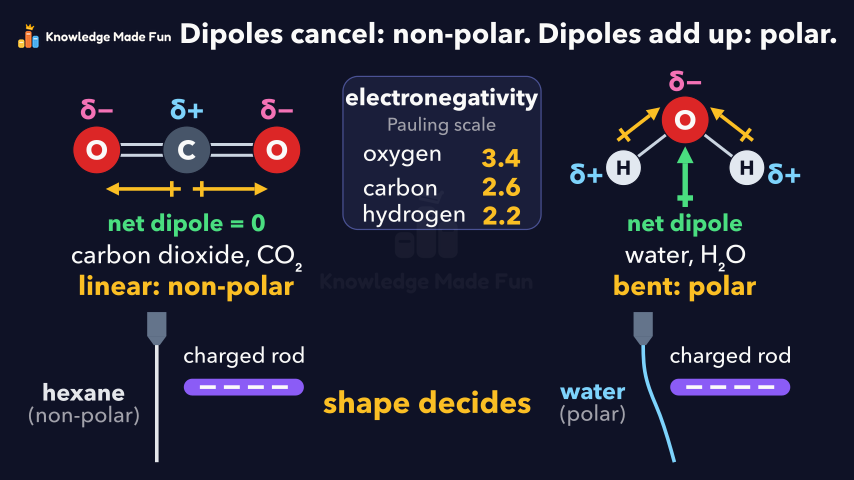 1 min 54 s
Polar Bonds, Polar Molecules: Shape Decides
Grade 11 · 1 min 54 s 1 min 40 s
Acids and bases: the pH scale
Grade 10 · 1 min 40 s
- All Grade 11 Chemistry lessons
- Create a free account to watch three lessons a day, no payment and no card.