Lesson · Grade 11 · Chemistry
Drawing Lewis structures step by step
- Grade 11
- Chemistry
- 2 min 3 s
- British Columbia
- BC11-SC-05
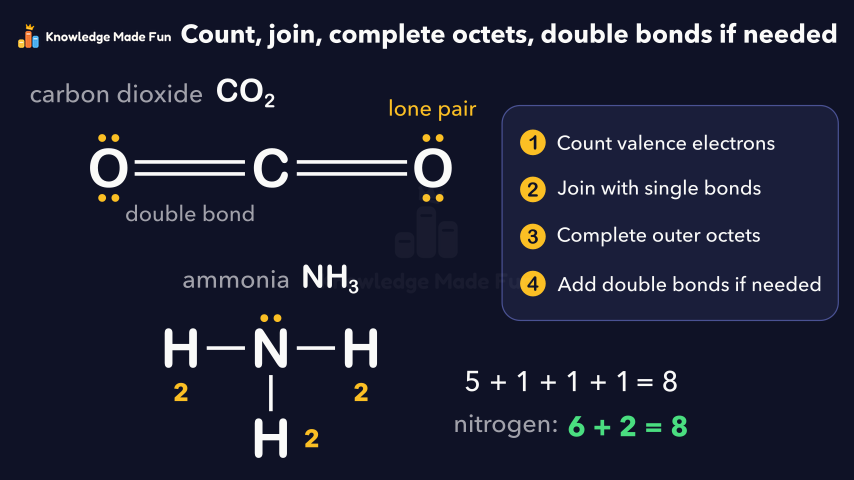
A labelled diagram of carbon dioxide is built up through four steps listed on the right, with a running count of electrons left to place. It goes from counting valence electrons (4 + 6 + 6 = 16), through single bonds and outer octets, to two double bonds giving O=C=O with two lone pairs on each oxygen (8 bonding + 8 lone pair = 16). The same steps then draw ammonia (5 + 1 + 1 + 1 = 8, three N–H bonds and one lone pair on nitrogen), showing that hydrogen is full with 2 electrons, not 8, before a one-line recap of the four steps.
Anyone can watch two lessons on the website without an account. Signing in is free, no payment and no card, and opens three a day; Plus has no limit.
Loading
In one sentence
The question this lesson answers
A Lewis structure shows where the outer electrons in a molecule are. How do you draw one?
Let's draw one for carbon dioxide, in four steps.
Transcript
What the lesson says
A Lewis structure shows where the outer electrons in a molecule are. How do you draw one?
Let's draw one for carbon dioxide, in four steps.
Step one: count the valence electrons, the electrons in each atom's outer shell.
Carbon has 4 and each oxygen has 6.
So 4 plus 6 plus 6 makes 16 valence electrons to place.
Step two: put carbon in the centre and join each oxygen to it with a single bond.
A single bond is one shared pair of electrons, so two bonds use 4, leaving 12.
Step three: give each outer atom an octet, which means 8 electrons around it.
Each oxygen needs 6 more, so it gets 3 lone pairs, pairs that are not shared, using the last 12.
Step four: check the central atom. Carbon has only 4 electrons, not an octet.
So one lone pair on each oxygen becomes a second shared pair, making two double bonds.
Now carbon has 8, and each oxygen has 4 in bonds plus 4 in lone pairs, which is 8.
Check: 8 bonding plus 8 lone pair electrons makes 16, as we counted.
For ammonia, nitrogen has 5 valence electrons and each of the 3 hydrogens has 1, making 8.
Three single bonds to hydrogen use 6 electrons, leaving 2.
Hydrogen is full with just 2 electrons, not 8, so it gets no lone pairs.
The last 2 make a lone pair on nitrogen, giving it 6 plus 2, which is 8.
So: count the valence electrons, join with single bonds, complete the outer octets, then add double bonds if needed.
Curriculum
Where this fits
- British Columbia, Grade 11
Chemistry 11, Bonding: valence electrons and Lewis structuresBC11-SC-05
Previous: Electron Pairs Push Apart: VSEPR Molecule ShapesNext: Ionic and Covalent Bonds: Transfer or Share?
The outcomes and strands follow the British Columbia curriculum.
Keep going
 1 min 58 s
Dispersion and Dipole Forces: Why Some Substances Boil Higher
Grade 11 · 1 min 58 s 1 min 55 s
Electron Pairs Push Apart: VSEPR Molecule Shapes
Grade 11 · 1 min 55 s 1 min 58 s
Electronegativity difference decides the bond type
Grade 11 · 1 min 58 s 1 min 40 s
Forces Inside Molecules vs Forces Between Molecules
Grade 11 · 1 min 40 s 1 min 56 s
Hydrogen Bonds: Why Water Boils at 100 °C
Grade 11 · 1 min 56 s 1 min 56 s
Ionic and Covalent Bonds: Transfer or Share?
Grade 11 · 1 min 56 s 1 min 54 s
Polar Bonds, Polar Molecules: Shape Decides
Grade 11 · 1 min 54 s 1 min 40 s
Acids and bases: the pH scale
Grade 10 · 1 min 40 s
- All Grade 11 Chemistry lessons
- Create a free account to watch three lessons a day, no payment and no card.