Lesson · Grade 11 · Chemistry
Dispersion and Dipole Forces: Why Some Substances Boil Higher
- Grade 11
- Chemistry
- 1 min 58 s
- British Columbia
- BC11-SC-10
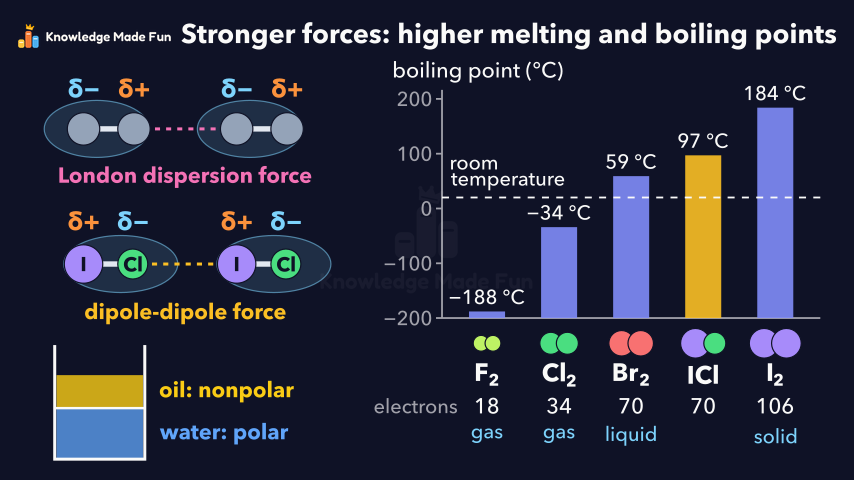
A close-up of two molecules shows moving electrons making a temporary dipole that gives the next molecule a dipole too: a London dispersion force. A chart of the halogens then shows boiling points rising with the number of electrons (F₂ and Cl₂ gases, Br₂ a liquid, I₂ a solid), and polar ICl, with the same 70 electrons as Br₂, boils at 97 °C instead of 59 °C because of dipole-dipole forces. The video ends with oil and water staying in separate layers (like dissolves like) and the recap that stronger forces between molecules mean higher melting and boiling points.
Anyone can watch two lessons on the website without an account. Signing in is free, no payment and no card, and opens three a day; Plus has no limit.
Loading
In one sentence
The question this lesson answers
Why do some substances boil so much higher than others?
Boiling overcomes intermolecular forces, the attractions between molecules. The bonds inside each molecule do not break.
Transcript
What the lesson says
Why do some substances boil so much higher than others?
Boiling overcomes intermolecular forces, the attractions between molecules. The bonds inside each molecule do not break.
For an instant, moving electrons can make one end slightly negative and the other slightly positive: a temporary dipole.
Its positive end pulls the next molecule's electrons, giving it a dipole too, so the two attract.
This is a London dispersion force, and it acts between all molecules.
More electrons usually mean stronger dispersion forces: a bigger cloud shifts more easily.
A fluorine molecule has 18 electrons, chlorine 34, bromine 70 and iodine 106.
Their boiling points rise in the same order: minus 188, minus 34, 59 and 184 degrees Celsius.
At room temperature, fluorine and chlorine are gases, bromine is a liquid and iodine is a solid.
In iodine monochloride, chlorine pulls the shared electrons harder: its end is always slightly negative, the iodine end slightly positive.
This molecule is polar. Opposite ends of neighbouring molecules attract: a dipole-dipole force.
Iodine monochloride has 70 electrons, like bromine, but this extra force makes it boil at 97 degrees, not 59.
Like dissolves like: polar tends to mix with polar. Water is polar and oil is nonpolar, so they stay in separate layers.
Stronger forces between molecules take more energy to overcome, so melting and boiling points are higher.
Curriculum
Where this fits
- British Columbia, Grade 11
Chemistry 11, Bonding: bonds/forcesBC11-SC-10
Previous: Forces Inside Molecules vs Forces Between MoleculesNext: Hydrogen Bonds: Why Water Boils at 100 °C
The outcomes and strands follow the British Columbia curriculum.
Keep going
 2 min 3 s
Drawing Lewis structures step by step
Grade 11 · 2 min 3 s 1 min 55 s
Electron Pairs Push Apart: VSEPR Molecule Shapes
Grade 11 · 1 min 55 s 1 min 58 s
Electronegativity difference decides the bond type
Grade 11 · 1 min 58 s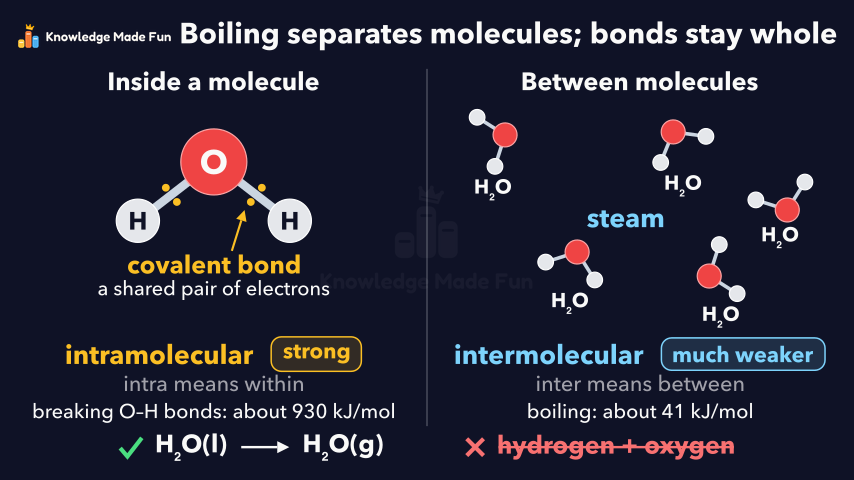 1 min 40 s
Forces Inside Molecules vs Forces Between Molecules
Grade 11 · 1 min 40 s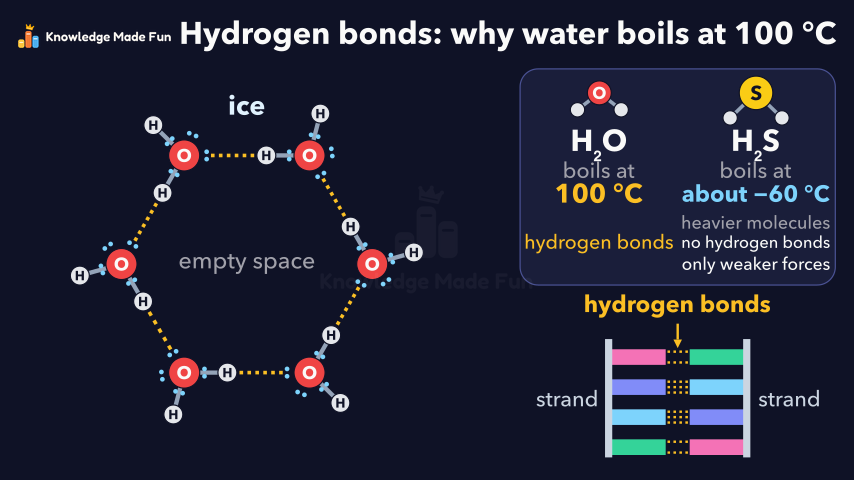 1 min 56 s
Hydrogen Bonds: Why Water Boils at 100 °C
Grade 11 · 1 min 56 s 1 min 56 s
Ionic and Covalent Bonds: Transfer or Share?
Grade 11 · 1 min 56 s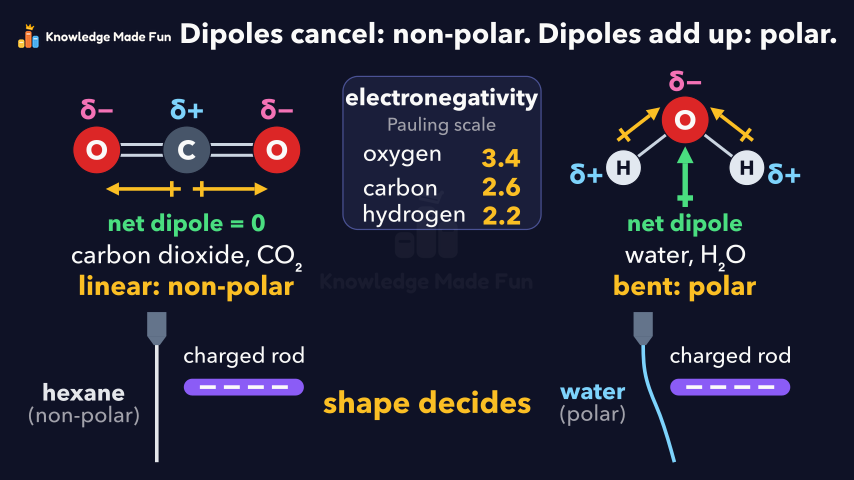 1 min 54 s
Polar Bonds, Polar Molecules: Shape Decides
Grade 11 · 1 min 54 s 1 min 40 s
Acids and bases: the pH scale
Grade 10 · 1 min 40 s
- All Grade 11 Chemistry lessons
- Create a free account to watch three lessons a day, no payment and no card.