Lesson · Grade 11 · Foundations of Mathematics
The Square-Cube Law: Why Giants Can't Just Be Scaled Up
- Grade 11
- Foundations of Mathematics
- 1 min 58 s
- British Columbia
- BC11-MA-36
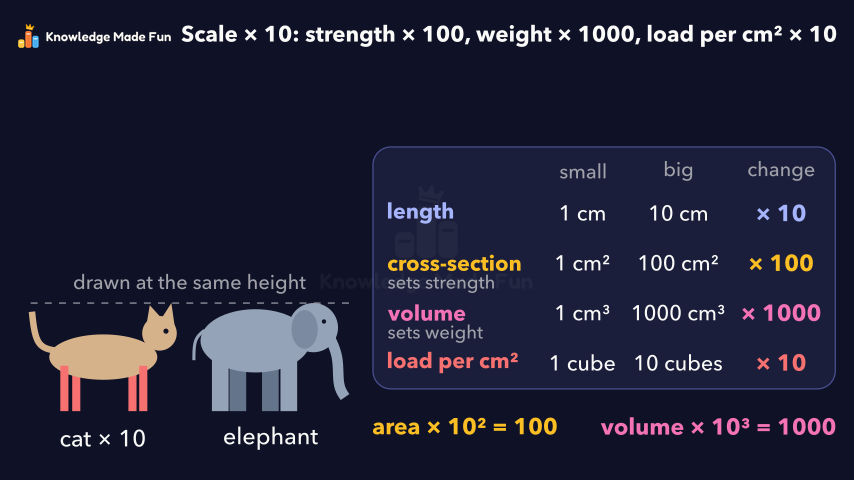
Using a 1 cm cube scaled up to 10 cm, the video shows that the cross-section, which sets bone strength, grows 10 × 10 = 100 times, while the volume, which sets weight, grows 10 × 10 × 10 = 1000 times, so each square centimetre carries 1000 ÷ 100 = 10 times the load. It then shows why a scaled-up cat's legs could break and why an elephant has much thicker legs for its size than a cat, and warns against expecting a design that works small to work the same way at full size.
Concept: The square-cube law: why giants cannot just be scaled up
Anyone can watch two lessons on the website without an account. Signing in is free, no payment and no card, and opens three a day; Plus has no limit.
Loading
In one sentence
The question this lesson answers
Could a cat made 10 times bigger still stand on its legs?
A scale factor of 10 means every length is multiplied by 10.
Transcript
What the lesson says
Could a cat made 10 times bigger still stand on its legs?
A scale factor of 10 means every length is multiplied by 10.
Model the animal as a cube, 1 centimetre on each side, scaled up to 10 centimetres.
Bone strength depends on cross-section: the area of a cut straight across, like this slice.
The big cross-section is 10 by 10, or 100 square centimetres, so it is 100 times as strong.
Weight depends on volume, the space it fills.
The big cube holds 10 layers of 100 small cubes: 1000 cubic centimetres, so 1000 times as heavy.
So strength grows 100 times, but weight grows 1000 times.
Load per square centimetre is weight divided by cross-section: 1000 divided by 100 is 10 times as much.
Check: each square of the big cross-section holds up a column of 10 cubes, not just 1.
This is the square-cube law: area grows by 10 squared, or 100, and volume by 10 cubed, or 1000.
A cat scaled up 10 times puts 10 times the load on each square centimetre of bone, so its legs could break.
That is why an elephant has much thicker legs for its size than a cat.
A common mistake is expecting a design that works small to work the same way at full size.
Scale up 10 times: strength grows 100 times, weight 1000 times, so each square centimetre carries 10 times the load.
Curriculum
Where this fits
- British Columbia, Grade 11
Foundations of Mathematics 11, Geometry: scale modelsBC11-MA-36
Previous: Scale Factor: Lengths by k, Areas by k², Volumes by k³
The outcomes and strands follow the British Columbia curriculum.
Keep going
 1 min 58 s
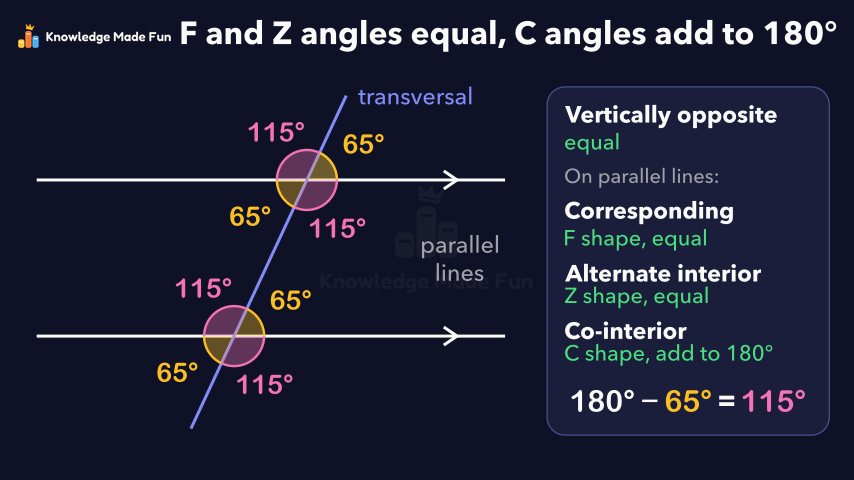
Angles made by parallel lines and a transversal
Grade 11 · 1 min 58 s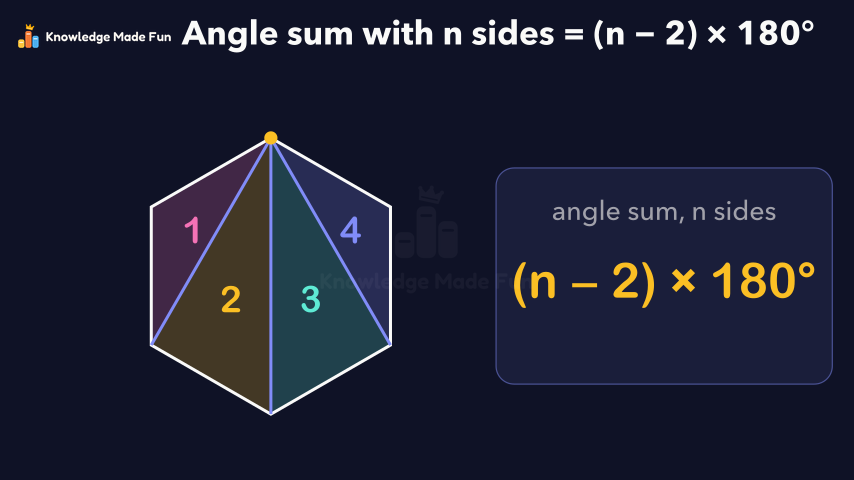 2 min 16 s
Proving the angle sums of triangles and polygons
Grade 11 · 2 min 16 s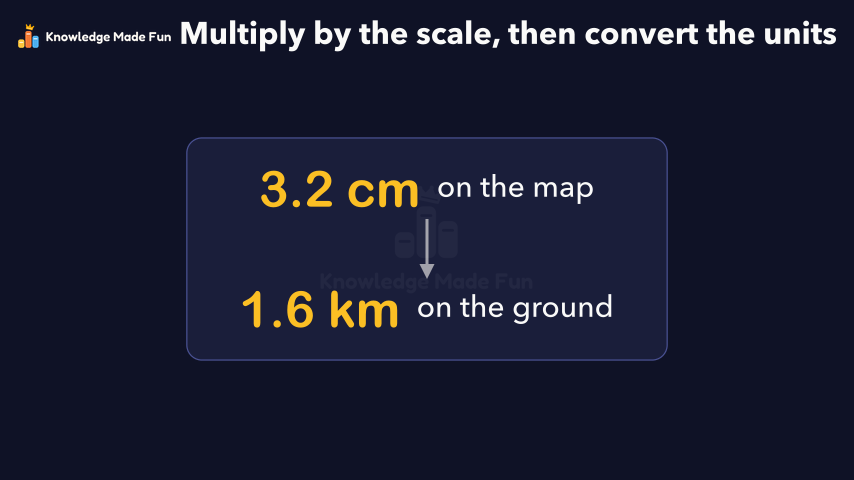 1 min 57 s
Reading a Map Scale: From Centimetres to Kilometres
Grade 9 · 1 min 57 s 2 min 10 s
Scale Factor: Lengths by k, Areas by k², Volumes by k³
Grade 11 · 2 min 10 s 1 min 46 s
Top, Front and Side Views of a 3D Object
Grade 8 · 1 min 46 s 2 min 9 s
Why the Pythagorean theorem works: a rearrangement proof
Grade 8 · 2 min 9 s 2 min 11 s
Adding and Subtracting Rational Expressions
Grade 11 · 2 min 11 s 2 min 3 s
Angles in Standard Position and Reference Angles
Grade 11 · 2 min 3 s
- All Grade 11 Foundations of Mathematics lessons
- Create a free account to watch three lessons a day, no payment and no card.