Lesson · Grade 11 · Foundations of Mathematics
Proving the angle sums of triangles and polygons
- Grade 11
- Foundations of Mathematics
- 2 min 16 s
- British Columbia
- BC11-MA-25
A line through the top vertex, parallel to the base, copies a triangle's two base angles to the top as alternate angles, where the three angles lie on a straight line and add to 180°. Splitting a hexagon from one vertex into 6 − 2 = 4 triangles gives 4 × 180° = 720°, so each angle of a regular hexagon is 120°; splitting from the centre gives 1080° and needs the 360° around the centre taken away.
Anyone can watch two lessons on the website without an account. Signing in is free, no payment and no card, and opens three a day; Plus has no limit.
Loading
In one sentence
The question this lesson answers
Why do a triangle's angles always add to 180 degrees? Let's prove it.
Call its interior angles, the angles inside at each corner, a, b and c.
Transcript
What the lesson says
Why do a triangle's angles always add to 180 degrees? Let's prove it.
Call its interior angles, the angles inside at each corner, a, b and c.
Through the top vertex, or corner, draw a line parallel to the base. Parallel lines never meet.
A transversal, a line crossing two parallel lines, makes a Z shape. The alternate angles inside the Z are equal.
The same rule copies angle c up to the top.
Now b, a and c sit on a straight line, so they add to 180 degrees.
So a plus b plus c is 180 degrees, in every triangle.
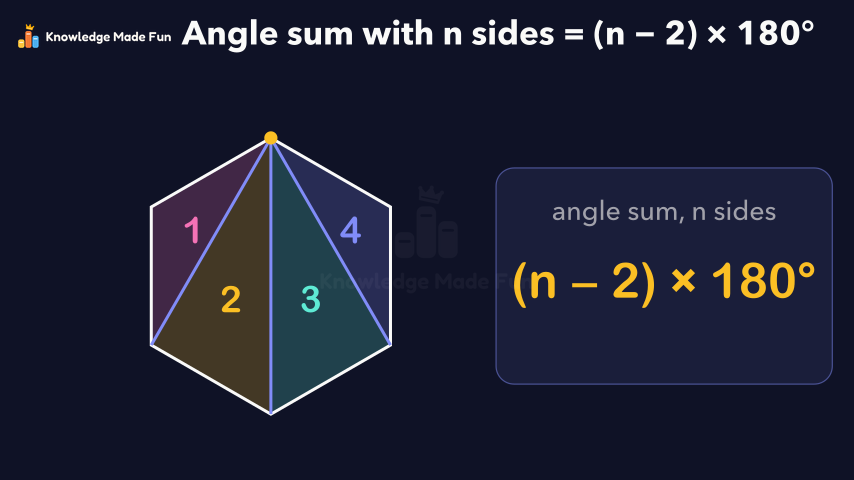
A polygon is a closed flat shape with straight sides. This hexagon has 6.
From one vertex, draw the diagonals, lines to each corner not next to it.
That splits it into 1, 2, 3, 4 triangles.
Each sits on a side away from that vertex, so n sides make n minus 2 triangles: 6 minus 2 is 4.
Their angles fill the hexagon's corners, so the angle sum, the total of its angles, is 4 times 180, or 720 degrees.
A regular hexagon has equal sides and equal angles, so each angle is 720 divided by 6, or 120 degrees.
A common mistake: split from the centre into 6 triangles, and get 6 times 180, or 1080 degrees.
But the angles around the centre make a full turn, 360 degrees, and are not angles of the hexagon.
Take them away: 1080 minus 360 is 720 degrees, the same answer.
Recap: a polygon with n sides has an angle sum of n minus 2, times 180 degrees.
Curriculum
Where this fits
- British Columbia, Grade 11
Foundations of Mathematics 11, Geometry: angle relationshipsBC11-MA-25
Previous: Angles made by parallel lines and a transversalNext: Scale Factor: Lengths by k, Areas by k², Volumes by k³
The outcomes and strands follow the British Columbia curriculum.
Keep going
 1 min 58 s
Angles made by parallel lines and a transversal
Grade 11 · 1 min 58 s 1 min 57 s
Reading a Map Scale: From Centimetres to Kilometres
Grade 9 · 1 min 57 s 2 min 10 s
Scale Factor: Lengths by k, Areas by k², Volumes by k³
Grade 11 · 2 min 10 s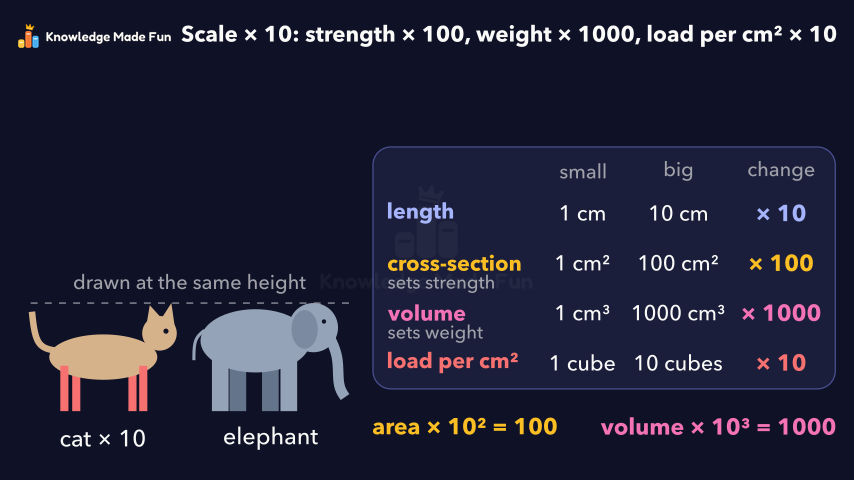 1 min 58 s
The Square-Cube Law: Why Giants Can't Just Be Scaled Up
Grade 11 · 1 min 58 s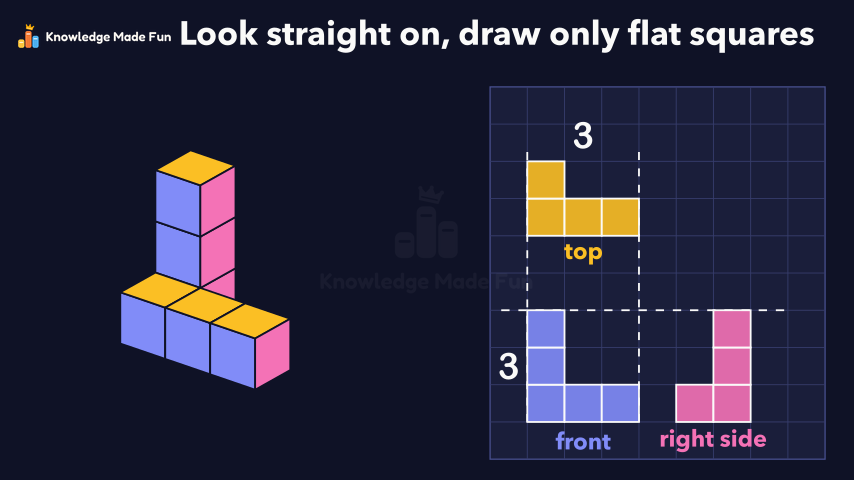 1 min 46 s
Top, Front and Side Views of a 3D Object
Grade 8 · 1 min 46 s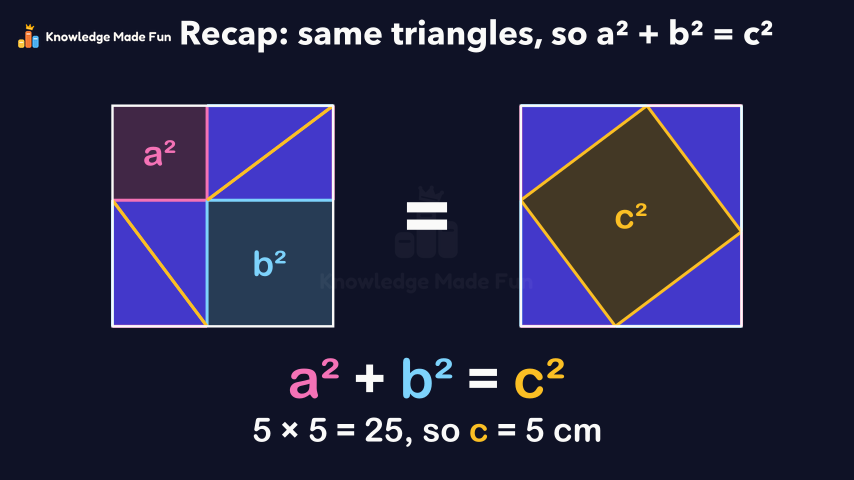 2 min 9 s
Why the Pythagorean theorem works: a rearrangement proof
Grade 8 · 2 min 9 s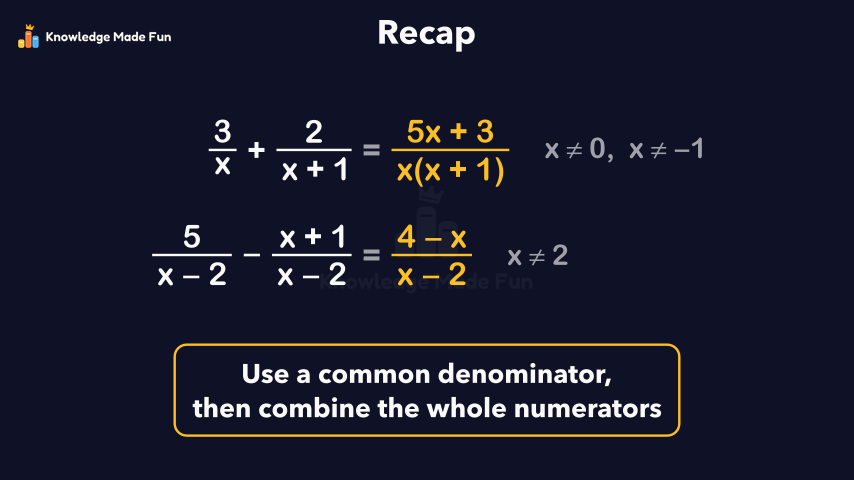 2 min 11 s
Adding and Subtracting Rational Expressions
Grade 11 · 2 min 11 s 2 min 3 s
Angles in Standard Position and Reference Angles
Grade 11 · 2 min 3 s
- All Grade 11 Foundations of Mathematics lessons
- Create a free account to watch three lessons a day, no payment and no card.