Lesson · Grade 6 · English Language Arts
Transition words: link your sentences
- Grade 6
- English Language Arts
- 1 min 13 s
- British Columbia
- BC6-EN-28
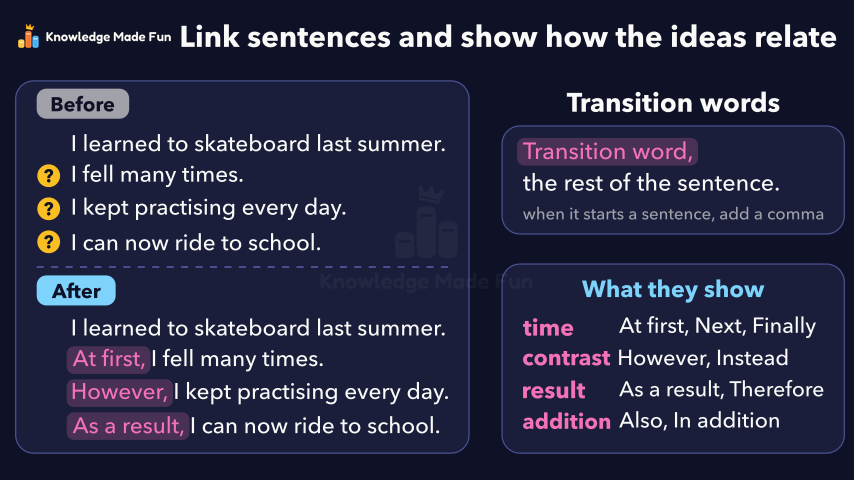
A short passage about learning to skateboard is shown twice: first as four correct but disconnected sentences, with a question mark wherever the reader has to guess how one sentence links to the last, then with "At first", "However" and "As a result" added at the start of each sentence after the first, each followed by a comma. A box on the right sorts common transition words by what they show (time, contrast, result, addition), and the recap is that transition words link sentences and show the reader how the ideas relate.
Concept: Transition words
Anyone can watch two lessons on the website without an account. Signing in is free, no payment and no card, and opens three a day; Plus has no limit.
Loading
In one sentence
The question this lesson answers
How do you help a reader move smoothly from one sentence to the next?
Here is a short passage about learning to skateboard.
Transcript
What the lesson says
How do you help a reader move smoothly from one sentence to the next?
Here is a short passage about learning to skateboard.
Every sentence is correct, but the reader has to work out how each one connects to the one before.
A transition word links a sentence to the one before it.
It tells the reader how the ideas relate: by time, contrast, result or addition.
Here is the same passage with transition words added.
The first sentence sets the scene, so it needs no transition word.
At first shows time: this is how things began.
However shows a contrast: the falls did not stop me.
As a result shows a result: all that practice paid off.
When a transition word starts a sentence, put a comma after it, as each one does here.
Now the reader always knows how the next idea connects, so the writing flows.
Transition words link your sentences and show the reader how the ideas connect.
Curriculum
Where this fits
- British Columbia, Grade 6
English Language Arts, Language features, structures, and conventions: sentence structure and grammarBC6-EN-28
Previous: Using Pronouns Correctly: Point Clearly to One Noun, and Match ItNext: Commas: a small pause that separates the parts of a sentence
- British Columbia, Grade 7
English Language Arts, Language features, structures, and conventions: syntax and sentence fluencyBC7-EN-32
Previous: Using Pronouns Correctly: Point Clearly to One Noun, and Match ItNext: Commas: a small pause that separates the parts of a sentence
This lesson is also listed in Grade 7.
The outcomes and strands follow the British Columbia curriculum.
Keep going
 42 s
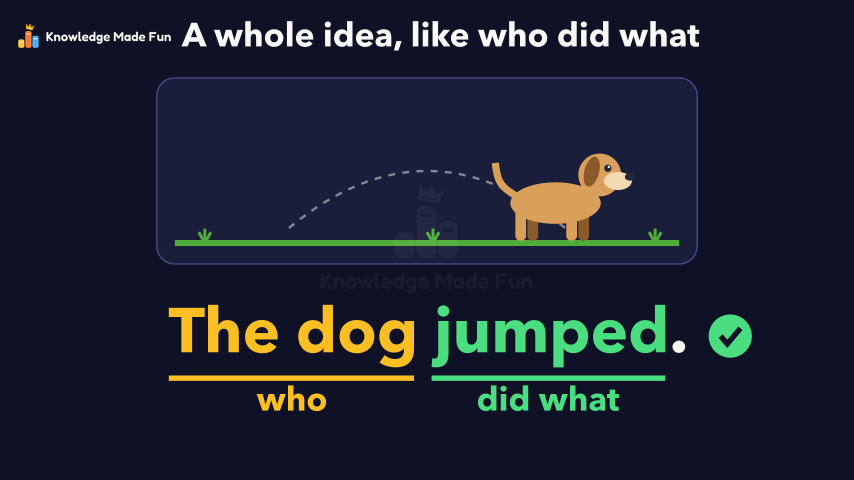
A Sentence Tells a Whole Idea: Who Did What
Grade 1 · 42 s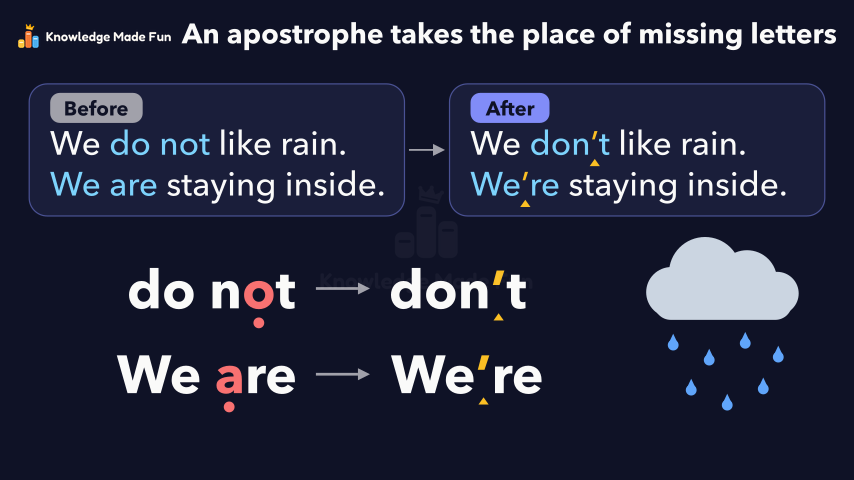 1 min 1 s
Apostrophes in Contractions: Do Not Becomes Don't
Grade 3 · 1 min 1 s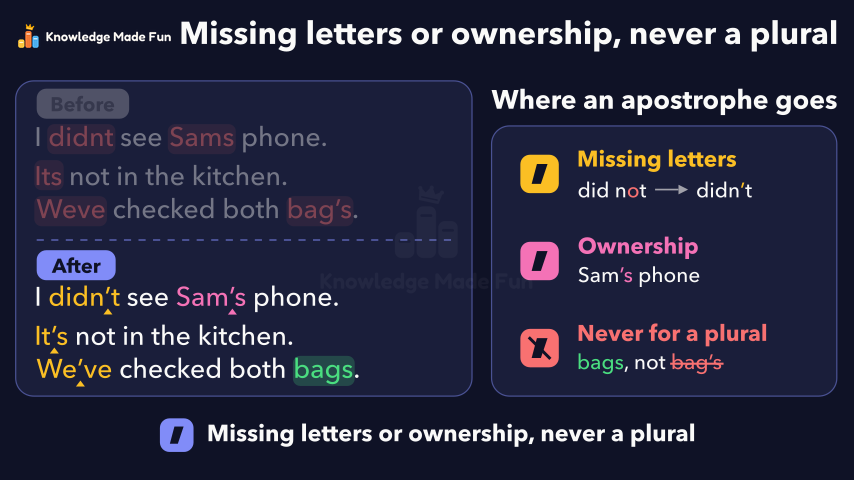 1 min 45 s
Apostrophes: Missing Letters or Ownership, Never a Plural
Grade 4 · 1 min 45 s 54 s
Blending and Splitting Sounds: c, a, t Makes cat
Grade 1 · 54 s 54 s
Blending Sounds: c, a, t Makes cat
Kindergarten · 54 s 1 min 5 s
Canadian and American Spelling: Two Ways, Both Correct
Grade 5 · 1 min 5 s 53 s
Capital Letters and End Marks
Grade 2 · 53 s 1 min 12 s
Capital Letters in Titles and Headings
Grade 5 · 1 min 12 s
- All Grade 6 English Language Arts lessons
- Create a free account to watch three lessons a day, no payment and no card.