Lesson · Grade 5 · Social Studies
Direct and Representative Democracy
- Grade 5
- Social Studies
- 1 min 2 s
- British Columbia
- BC5-SS-14
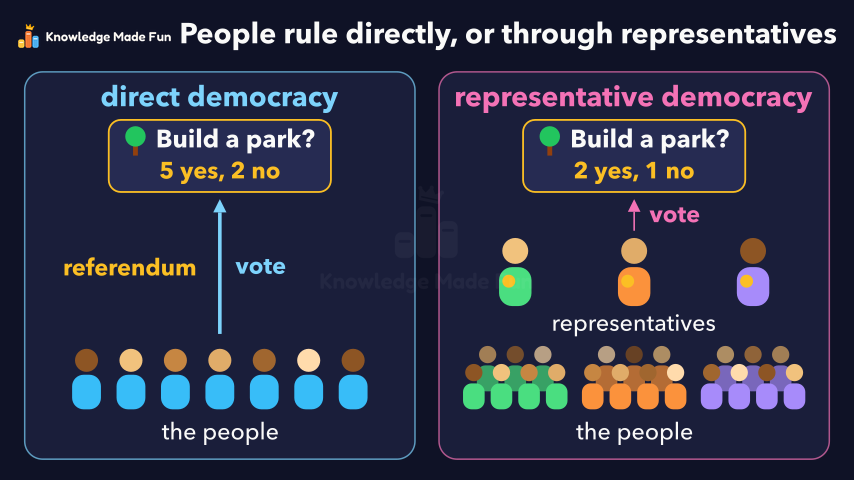
Two side-by-side cards show the same town question, "Build a park?": in direct democracy the people vote on it themselves, and in representative democracy they elect representatives who vote for everyone. The video adds that people can keep or replace their representatives at the next election and that a referendum lets all voters vote on one big question, then ends on the recap "People rule directly, or through representatives."
Anyone can watch two lessons on the website without an account. Signing in is free, no payment and no card, and opens three a day; Plus has no limit.
Loading
In one sentence
The question this lesson answers
Democracy means rule by the people.
There are two main kinds of democracy, direct and representative.
Transcript
What the lesson says
Democracy means rule by the people.
There are two main kinds of democracy, direct and representative.
Imagine a town deciding whether to build a new park.
In a direct democracy, the people vote on it themselves.
Five vote yes and two vote no, so yes wins.
In a big place, it is hard for everyone to vote on every decision.
So in a representative democracy, people elect representatives to speak for them.
The representatives vote for everyone: two yes and one no.
At the next election, people can keep them or choose new ones.
Most democracies today mainly use representatives.
Sometimes all voters vote on one big question themselves, in a referendum.
In a democracy, people rule directly or through the representatives they elect.
Curriculum
Where this fits
- British Columbia, Grade 5
Social Studies, Government and land: participation and representation in Canada's system of governmentBC5-SS-14
Previous: How Governments Pay for Services: TaxesNext: How an Election Works: Ridings, Parties and Votes
The outcomes and strands follow the British Columbia curriculum.
Keep going
 1 min 1 s
Canada's Natural Resources: What Is Found Where
Grade 5 · 1 min 1 s 1 min 7 s
How an Election Works: Ridings, Parties and Votes
Grade 5 · 1 min 7 s 59 s
How Governments Pay for Services: Taxes
Grade 5 · 59 s 1 min 9 s
How Resources Create Jobs and Trade
Grade 5 · 1 min 9 s 57 s
Three Levels of Government
Grade 5 · 57 s 1 min 23 s
How Canada's National Symbols Came to Be
Grade 5 · 1 min 23 s 1 min 2 s
Push and pull factors: why people move to a new country
Grade 5 · 1 min 2 s 1 min 22 s
The Charter of Rights and Freedoms
Grade 5 · 1 min 22 s
- All Grade 5 Social Studies lessons
- Create a free account to watch three lessons a day, no payment and no card.