Lesson · Grade 8 · Mathematics
The Pythagorean Theorem: Squares on the Sides of a Right Triangle
- Grade 8
- Mathematics
- 1 min 58 s
- British Columbia
- BC8-MA-30
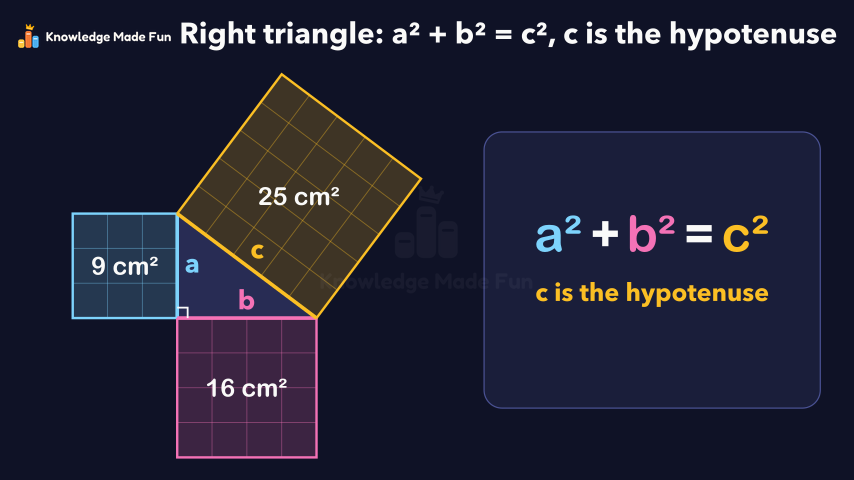
Squares drawn on the sides of a 3-4-5 right triangle have areas 9, 16 and 25 cm², and since 9 + 16 = 25, the squares on the two legs add up to the square on the hypotenuse: a² + b² = c². Opening the right angle until the third side is 6 cm shows the rule fails without a right angle (25 is not 36), and a common mistake shows why c must always be the hypotenuse, the longest side.
Anyone can watch two lessons on the website without an account. Signing in is free, no payment and no card, and opens three a day; Plus has no limit.
Loading
In one sentence
The question this lesson answers
How are the sides of a right triangle related?
A right triangle has a right angle, a square corner of 90 degrees.
Transcript
What the lesson says
How are the sides of a right triangle related?
A right triangle has a right angle, a square corner of 90 degrees.
Its sides are 3, 4 and 5 centimetres.
The side across from the right angle is the hypotenuse, the longest side.
The legs make the right angle: call them a and b. The hypotenuse is c.
Now draw a square on each side of the triangle.
The square on a has area 3 squared, 3 times 3, which is 9 square centimetres.
The square on b has area 4 squared, which is 16 square centimetres.
The square on c has area 5 squared, which is 25 square centimetres.
Add the two smaller areas: 9 plus 16 is 25, the area of the big square.
This is the Pythagorean theorem: in any right triangle, a squared plus b squared equals c squared.
Now open the corner to more than 90 degrees, so the third side is 6 centimetres.
3 squared plus 4 squared is still 25, but 6 squared is 36.
25 is not 36, so the theorem needs a right angle.
Back to our right triangle: a common mistake is putting the longest side as a or b.
That gives 9 plus 25, which is 34, but 4 squared is only 16.
c must be the hypotenuse, the longest side: 3 squared plus 4 squared equals 5 squared.
In a right triangle, a squared plus b squared equals c squared, where c is the hypotenuse.
Curriculum
Where this fits
- British Columbia, Grade 8
Mathematics, Geometry and measurement: Pythagorean theoremBC8-MA-30
Previous: Volume of a Cylinder: Base Area Times HeightNext: Why the Pythagorean theorem works: a rearrangement proof
The outcomes and strands follow the British Columbia curriculum.
Keep going
 1 min 12 s
3:15 p.m. or 15:15? Morning, afternoon and the 24-hour clock
Grade 4 · 1 min 12 s 1 min 26 s
3D Objects: Faces, Edges and Vertices
Grade 3 · 1 min 26 s 1 min 21 s
Area and Perimeter: What Is the Difference?
Grade 5 · 1 min 21 s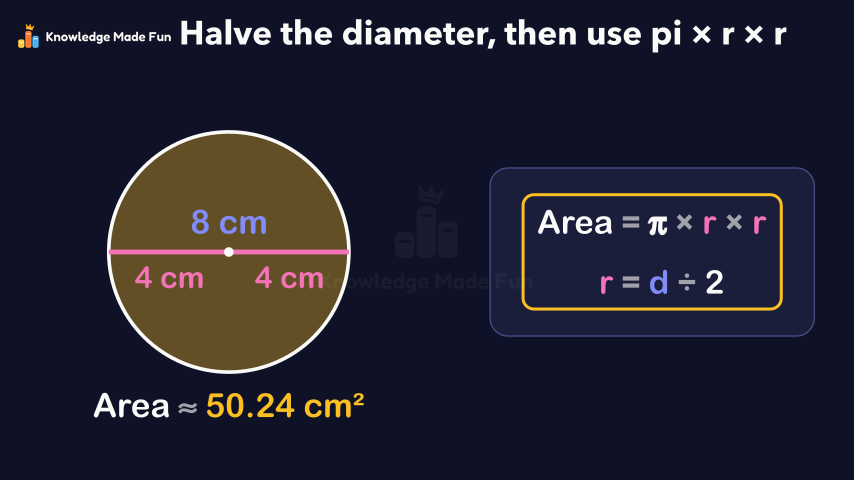 1 min 5 s
Area of a Circle from the Radius or the Diameter
Grade 7 · 1 min 5 s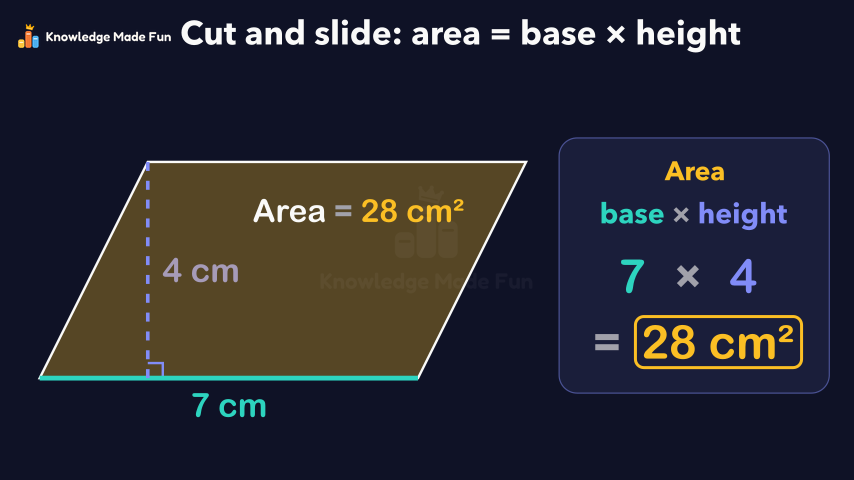 1 min 14 s
Area of a Parallelogram: Cut and Slide into a Rectangle
Grade 6 · 1 min 14 s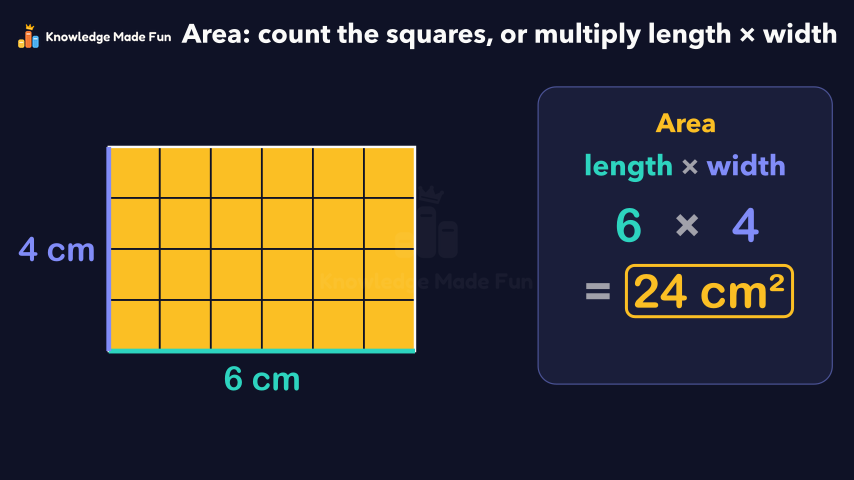 1 min 18 s
Area of a Rectangle: Count the Squares, Then Multiply
Grade 5 · 1 min 18 s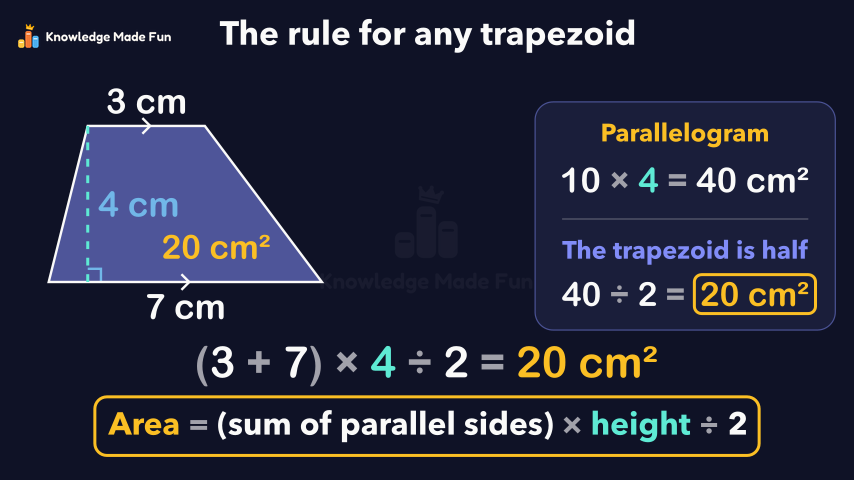 1 min 16 s
Area of a Trapezoid: Two Copies Make a Parallelogram
Grade 6 · 1 min 16 s 1 min 19 s
Area of a Triangle: Half of a Parallelogram
Grade 6 · 1 min 19 s
- All Grade 8 Mathematics lessons
- Try the graph paper, free for everyone, no account needed.
- Create a free account to watch three lessons a day, no payment and no card.