Lesson · Grade 6 · Mathematics
Area of a Trapezoid: Two Copies Make a Parallelogram
- Grade 6
- Mathematics
- 1 min 16 s
- British Columbia
- BC6-MA-32
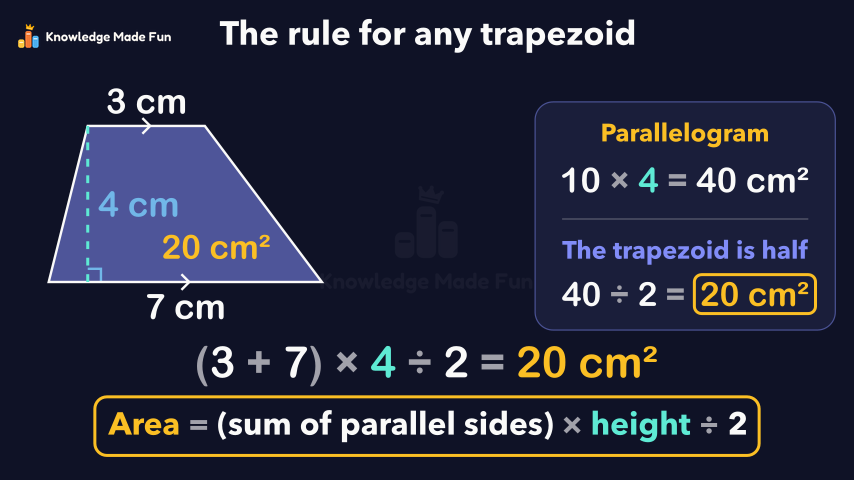
A trapezoid with parallel sides of 3 cm and 7 cm and a height of 4 cm is copied, turned a half turn and fitted beside itself to make a parallelogram 10 cm long and 4 cm high, with an area of 10 × 4 = 40 cm². The trapezoid is half of that, 20 cm², which leads to the rule: area = (sum of parallel sides) × height ÷ 2.
Concept: Area of a trapezoid
Anyone can watch two lessons on the website without an account. Signing in is free, no payment and no card, and opens three a day; Plus has no limit.
Loading
In one sentence
The question this lesson answers
How do we find the area of this trapezoid?
Its two parallel sides are 3 centimetres and 7 centimetres long.
Transcript
What the lesson says
How do we find the area of this trapezoid?
Its two parallel sides are 3 centimetres and 7 centimetres long.
The height is 4 centimetres, measured at a right angle to the parallel sides.
Make an exact copy of the trapezoid.
Turn the copy a half turn, so it is upside down.
Slide it in beside the first one. The two copies make a parallelogram.
The base of the parallelogram is 7 plus 3, which is 10 centimetres.
Its height is still 4 centimetres.
A parallelogram's area is base times height: 10 times 4 is 40 square centimetres.
The trapezoid is exactly half of the parallelogram, so 40 divided by 2 is 20 square centimetres.
So the area of the trapezoid is 20 square centimetres.
Put it all in one line: 3 plus 7, times 4, divided by 2, is 20 square centimetres.
For any trapezoid, the area is the sum of the parallel sides, times the height, divided by 2.
Curriculum
Where this fits
- British Columbia, Grade 6
Mathematics, Geometry and measurement: area of triangles, parallelograms, and trapezoidsBC6-MA-32
Previous: Area of a Triangle: Half of a ParallelogramNext: Five Types of Angles: Acute, Right, Obtuse, Straight and Reflex
The outcomes and strands follow the British Columbia curriculum.
Keep going
 1 min 12 s
3:15 p.m. or 15:15? Morning, afternoon and the 24-hour clock
Grade 4 · 1 min 12 s 1 min 26 s
3D Objects: Faces, Edges and Vertices
Grade 3 · 1 min 26 s 1 min 21 s
Area and Perimeter: What Is the Difference?
Grade 5 · 1 min 21 s 1 min 5 s
Area of a Circle from the Radius or the Diameter
Grade 7 · 1 min 5 s 1 min 14 s
Area of a Parallelogram: Cut and Slide into a Rectangle
Grade 6 · 1 min 14 s 1 min 18 s
Area of a Rectangle: Count the Squares, Then Multiply
Grade 5 · 1 min 18 s 1 min 19 s
Area of a Triangle: Half of a Parallelogram
Grade 6 · 1 min 19 s 1 min 4 s
Area: How Many Squares Cover a Shape
Grade 3 · 1 min 4 s
- All Grade 6 Mathematics lessons
- Teachers: the maths worksheets for Grade 6 are in the dashboard, each with a worked example and a proven answer key.
- Try the graph paper, free for everyone, no account needed.
- Create a free account to watch three lessons a day, no payment and no card.