Lesson · Grade 7 · Mathematics
The Four Quadrants
- Grade 7
- Mathematics
- 1 min 2 s
- British Columbia
- BC7-MA-55
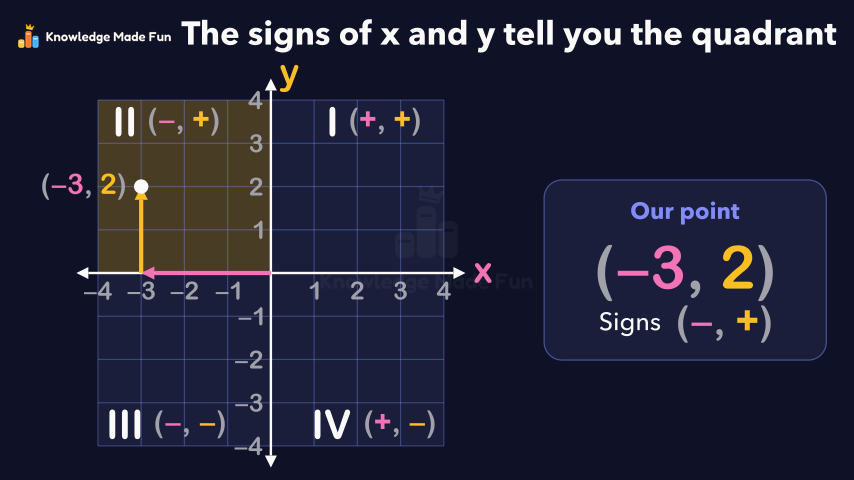
The x-axis and y-axis cross at the origin and cut the grid into four quadrants, numbered I to IV counterclockwise from the top right, each with its own pair of signs: (+, +), (−, +), (−, −) and (+, −). The worked example plots (−3, 2) by going left 3 and up 2, lands it in the second quadrant, and checks that its signs (−, +) match, ending on the recap that the signs of x and y tell you the quadrant.
Anyone can watch two lessons on the website without an account. Signing in is free, no payment and no card, and opens three a day; Plus has no limit.
Loading
In one sentence
The question this lesson answers
The x-axis and the y-axis cross at the origin, the point zero, zero.
The two axes cut the grid into four parts called quadrants.
Transcript
What the lesson says
The x-axis and the y-axis cross at the origin, the point zero, zero.
The two axes cut the grid into four parts called quadrants.
Which quadrant is the point negative 3, 2 in?
We number the quadrants counterclockwise, starting at the top right.
x is positive to the right of the y-axis and negative to the left.
y is positive above the x-axis and negative below it.
So each quadrant has its own pair of signs.
In our point, x is negative 3, so go 3 to the left.
y is 2, so go up 2.
The point lands in the second quadrant.
Its signs are negative then positive, just like the second quadrant.
The signs of x and y tell you which quadrant a point is in.
Curriculum
Where this fits
- British Columbia, Grade 7
Mathematics, Geometry and measurement: Cartesian coordinates and graphingBC7-MA-55
Previous: Volume of a Cylinder: Base Area Times HeightNext: Plotting a Point with Integer Coordinates
The outcomes and strands follow the British Columbia curriculum.
Keep going
 1 min 12 s
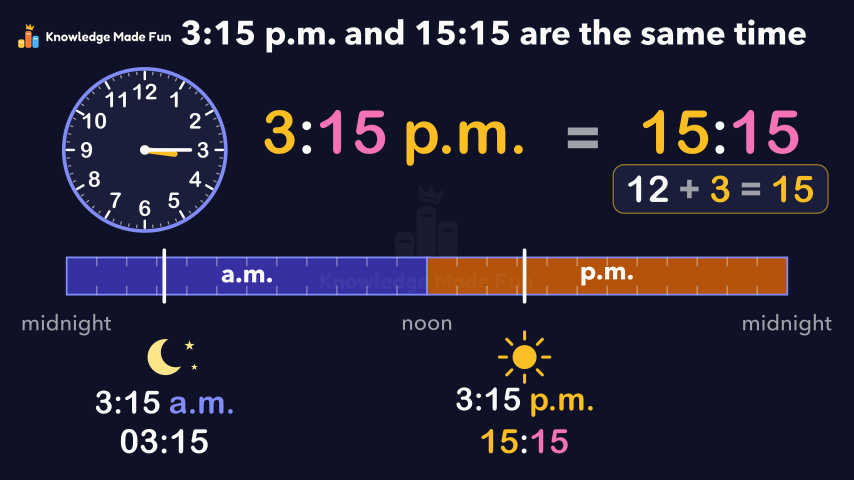
3:15 p.m. or 15:15? Morning, afternoon and the 24-hour clock
Grade 4 · 1 min 12 s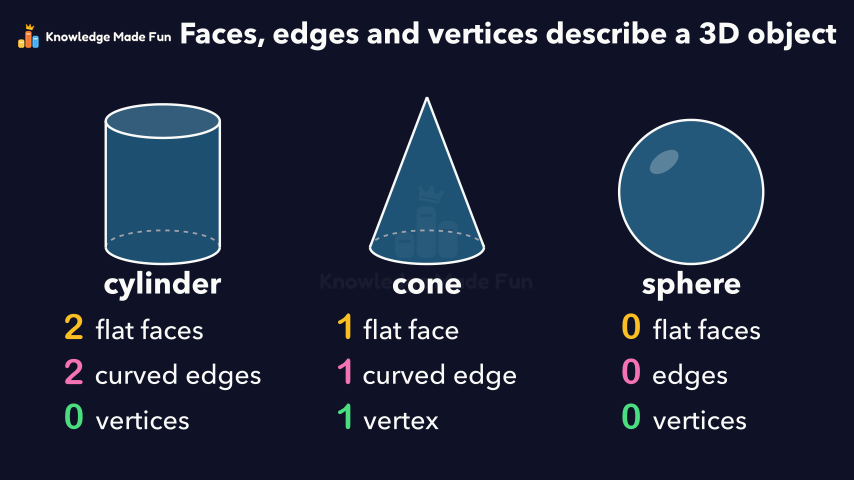 1 min 26 s
3D Objects: Faces, Edges and Vertices
Grade 3 · 1 min 26 s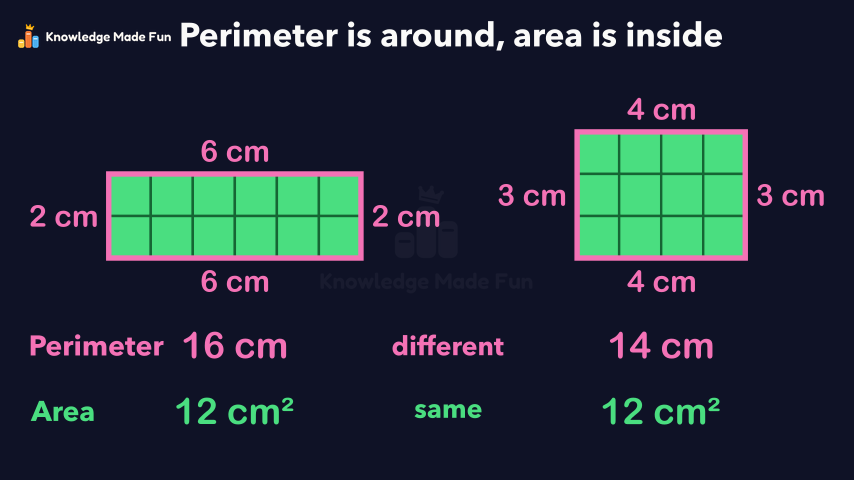 1 min 21 s
Area and Perimeter: What Is the Difference?
Grade 5 · 1 min 21 s 1 min 5 s
Area of a Circle from the Radius or the Diameter
Grade 7 · 1 min 5 s 1 min 14 s
Area of a Parallelogram: Cut and Slide into a Rectangle
Grade 6 · 1 min 14 s 1 min 18 s
Area of a Rectangle: Count the Squares, Then Multiply
Grade 5 · 1 min 18 s 1 min 16 s
Area of a Trapezoid: Two Copies Make a Parallelogram
Grade 6 · 1 min 16 s 1 min 19 s
Area of a Triangle: Half of a Parallelogram
Grade 6 · 1 min 19 s
- All Grade 7 Mathematics lessons
- Teachers: the maths worksheets for Grade 7 are in the dashboard, each with a worked example and a proven answer key.
- Try the graph paper, free for everyone, no account needed.
- Create a free account to watch three lessons a day, no payment and no card.