Lesson · Grade 10 · Workplace Mathematics
Rearranging a volume formula to find a missing height
- Grade 10
- Workplace Mathematics
- 2 min 19 s
- British Columbia
- BC10-MA-55
A can must hold 1000 cm³ with a radius of 5 cm, so the video rearranges V = πr²h to h = V ÷ πr² before putting in any numbers, then works out h = 1000 ÷ 78.54 ≈ 12.7 cm and checks it by putting the height back into the formula. It warns against dividing by 2r or πr, which are lengths and not areas, then uses the same idea on a 1.2 m³ box with a 1.5 m by 0.8 m base (height 1 m) and ends on the recap: height = volume ÷ base area.
Concept: Rearranging a volume formula to find a missing measurement
Anyone can watch two lessons on the website without an account. Signing in is free, no payment and no card, and opens three a day; Plus has no limit.
Loading
In one sentence
The question this lesson answers
A can must hold 1000 cubic centimetres, or 1 litre, with a radius of 5 centimetres. How tall must it be?
Volume is the amount of space inside a solid. For a cylinder, V equals pi r squared h.
Transcript
What the lesson says
A can must hold 1000 cubic centimetres, or 1 litre, with a radius of 5 centimetres. How tall must it be?
Volume is the amount of space inside a solid. For a cylinder, V equals pi r squared h.
r is the radius, from the centre of the circle to its edge, and h is the height.
Pi r squared is the area of the circle at the bottom, called the base area.
Before putting in numbers, rearrange the formula to get h on its own. This is called making h the subject.
h is multiplied by pi r squared, so divide both sides by pi r squared.
On the right, pi r squared cancels, leaving h equals V divided by pi r squared.
Now the numbers. The base area is pi times 5 squared, about 78.54 square centimetres.
So h equals 1000 divided by 78.54, which is about 12.73.
To one decimal place, the can must be about 12.7 centimetres tall.
Check by putting 12.73 back in: pi times 5 squared times 12.73 is about 1000 cubic centimetres.
A common mistake is to divide by 2r or pi r. Those are lengths, not areas. The base area is pi r squared.
The same idea works for a box holding 1.2 cubic metres, on a base 1.5 metres by 0.8 metres.
Its base area is 1.5 times 0.8, which is 1.2 square metres.
So the height is 1.2 divided by 1.2, which is 1 metre. Check: 1.5 times 0.8 times 1 is 1.2.
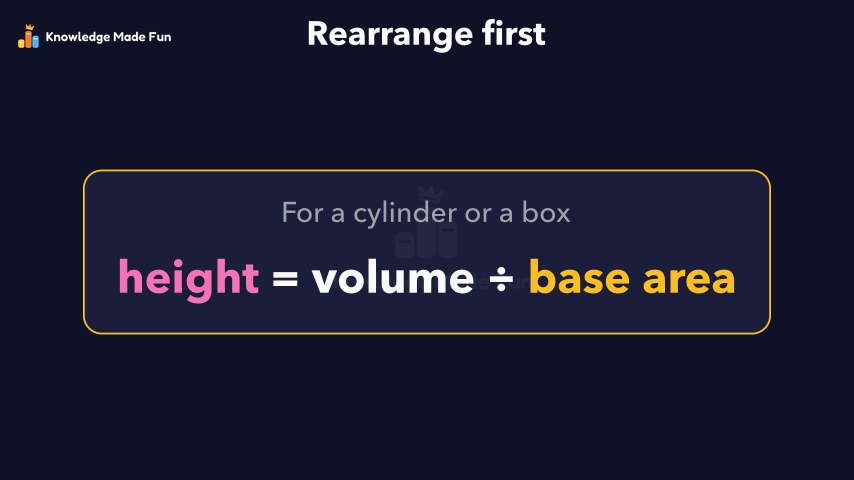
For a cylinder or a box, rearrange first: height equals volume divided by base area.
Curriculum
Where this fits
- British Columbia, Grade 10
Workplace Mathematics 10, Geometry and measurement: surface area and volumeBC10-MA-55
Previous: Converting between metric and imperial lengthsNext: Surface Area or Volume? What the Job Needs
The outcomes and strands follow the British Columbia curriculum.
Keep going
 1 min 12 s
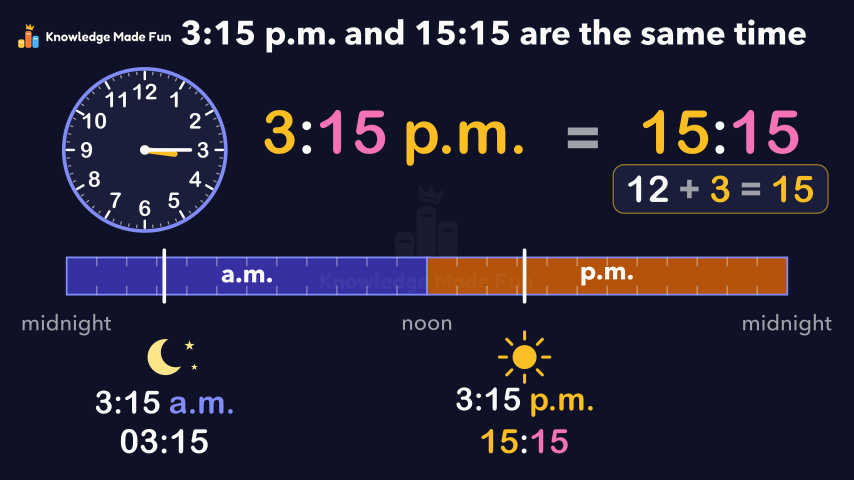
3:15 p.m. or 15:15? Morning, afternoon and the 24-hour clock
Grade 4 · 1 min 12 s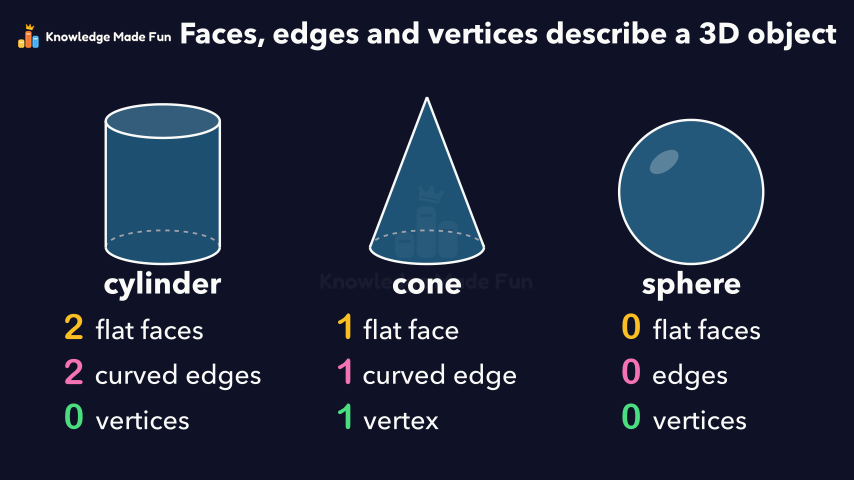 1 min 26 s
3D Objects: Faces, Edges and Vertices
Grade 3 · 1 min 26 s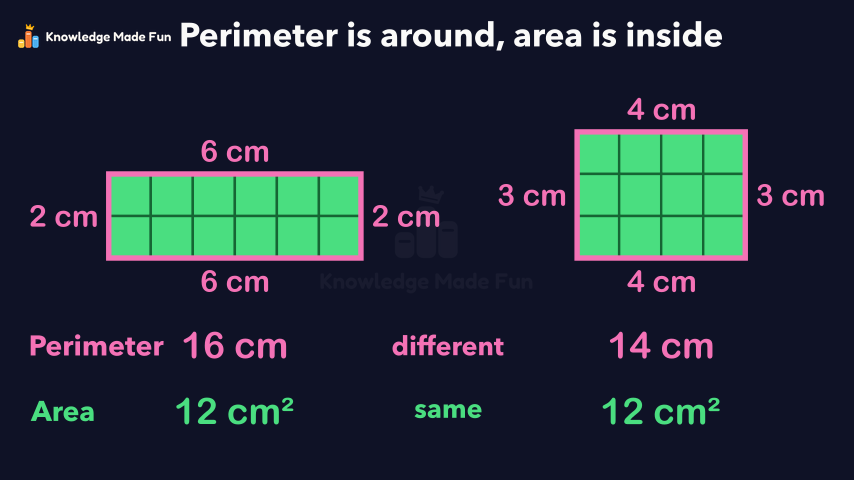 1 min 21 s
Area and Perimeter: What Is the Difference?
Grade 5 · 1 min 21 s 1 min 5 s
Area of a Circle from the Radius or the Diameter
Grade 7 · 1 min 5 s 1 min 14 s
Area of a Parallelogram: Cut and Slide into a Rectangle
Grade 6 · 1 min 14 s 1 min 18 s
Area of a Rectangle: Count the Squares, Then Multiply
Grade 5 · 1 min 18 s 1 min 16 s
Area of a Trapezoid: Two Copies Make a Parallelogram
Grade 6 · 1 min 16 s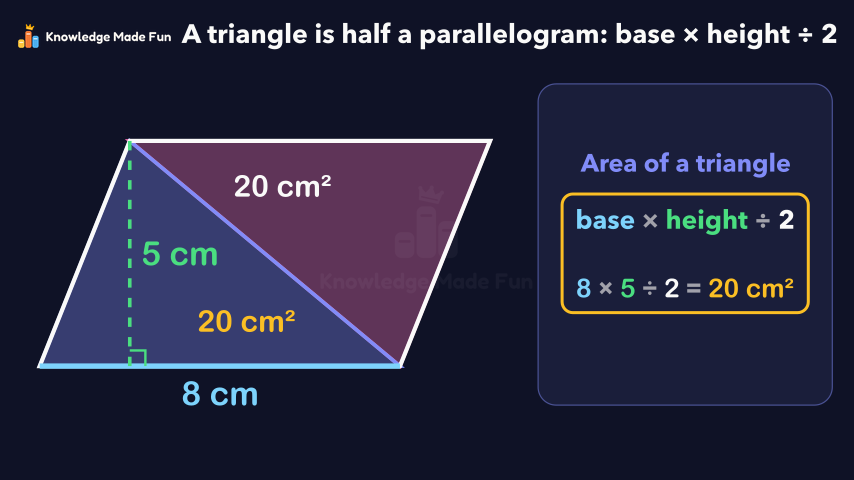 1 min 19 s
Area of a Triangle: Half of a Parallelogram
Grade 6 · 1 min 19 s
- All Grade 10 Workplace Mathematics lessons
- Create a free account to watch three lessons a day, no payment and no card.