Lesson · Grade 9 · Mathematics
Horizontal and vertical lines: y = 3 and x = −2
- Grade 9
- Mathematics
- 2 min 1 s
- British Columbia
- BC9-MA-17
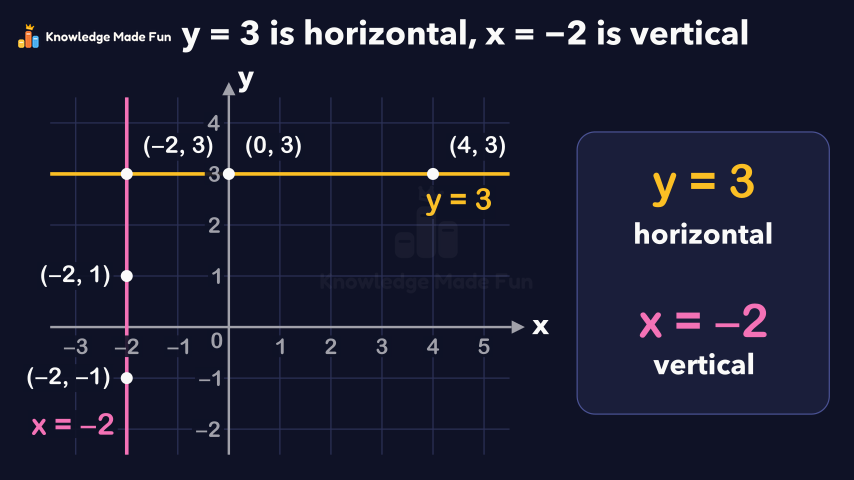
On one coordinate grid, the points (−2, 3), (0, 3) and (4, 3) are plotted and listed in a table, and since every y-coordinate is 3 they join into the horizontal line y = 3. The video then corrects the common mistake of drawing y = 3 as a vertical line, since its points (3, 1) and (3, 4) make the line x = 3, and plots (−2, −1), (−2, 1) and (−2, 3) to build the vertical line x = −2, which crosses y = 3 at (−2, 3).
Concept: Horizontal and vertical lines: y = 3 and x = -2
Anyone can watch two lessons on the website without an account. Signing in is free, no payment and no card, and opens three a day; Plus has no limit.
Loading
In one sentence
The question this lesson answers
What does the graph of y equals 3 look like? Let's plot some points and see.
Each point is an ordered pair, x then y: x tells you how far across, and y how far up.
Transcript
What the lesson says
What does the graph of y equals 3 look like? Let's plot some points and see.
Each point is an ordered pair, x then y: x tells you how far across, and y how far up.
Start with negative 2, 3. From the origin, where the axes cross, go 2 left, then 3 up.
Now plot 0, 3 and 4, 3. Each is also 3 units up.
The second number in each pair is the y-coordinate. Here it is 3, 3 and 3.
Join the points. They make a horizontal line, one that runs straight across.
Other points on it, like 2, 3 or negative 3, 3, also have a y-coordinate of 3.
Whatever x is, y is always 3, so the equation of this line is y equals 3.
A common mistake is drawing y equals 3 as a vertical, up-and-down line through 3 on the x-axis.
But points on that line, like 3, 1 and 3, 4, have 3 as their first number, the x-coordinate. So it is the line x equals 3.
Now keep x the same instead. Plot negative 2, negative 1 and negative 2, 1.
With negative 2, 3 from before, the x-coordinate is negative 2 every time.
Join them. They make a vertical line, straight up and down, with the equation x equals negative 2.
The two lines cross at negative 2, 3, where x is negative 2 and y is 3.
So y equals 3 is a horizontal line, and x equals negative 2 is a vertical line.
Curriculum
Where this fits
- British Columbia, Grade 9
Mathematics, Patterns and algebra: two-variable linear relations, using graphing, interpolation, and extrapolationBC9-MA-17
Previous: Graphing y = ½x + 2 and Reading Between the PointsNext: Interpolating and extrapolating from a linear graph
- British Columbia, Grade 10
Foundations of Mathematics and Pre Calculus 10, Linear relations: linear functions: slope and equations of linesBC10-MA-18
Previous: Parallel and perpendicular lines: equal slopes and negative reciprocalsNext: Writing the equation of a line from a table of values
This lesson is also listed in Grade 10.
The outcomes and strands follow the British Columbia curriculum.
Keep going
 2 min 18 s
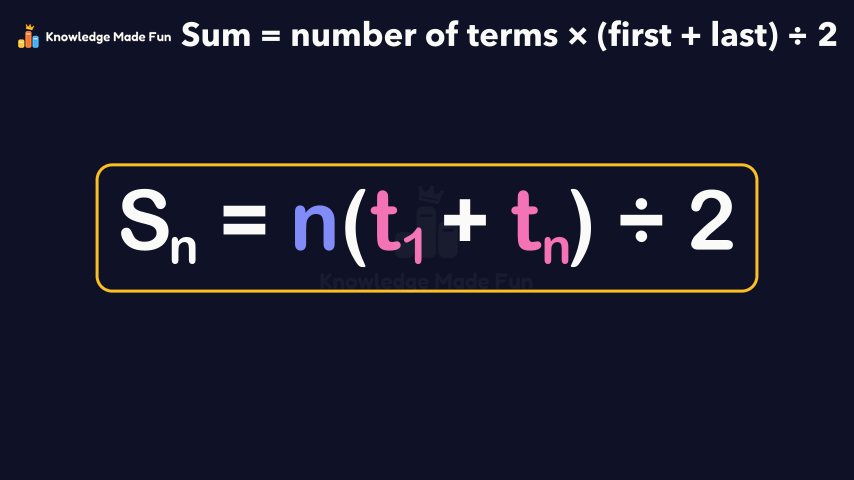
Adding an Arithmetic Series by Pairing Terms
Grade 10 · 2 min 18 s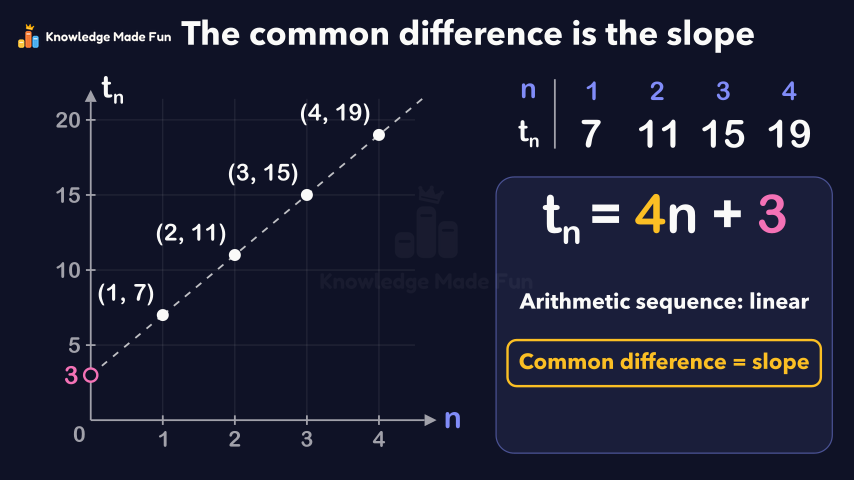 2 min 11 s
Arithmetic Sequences Are Linear: The Common Difference Is the Slope
Grade 10 · 2 min 11 s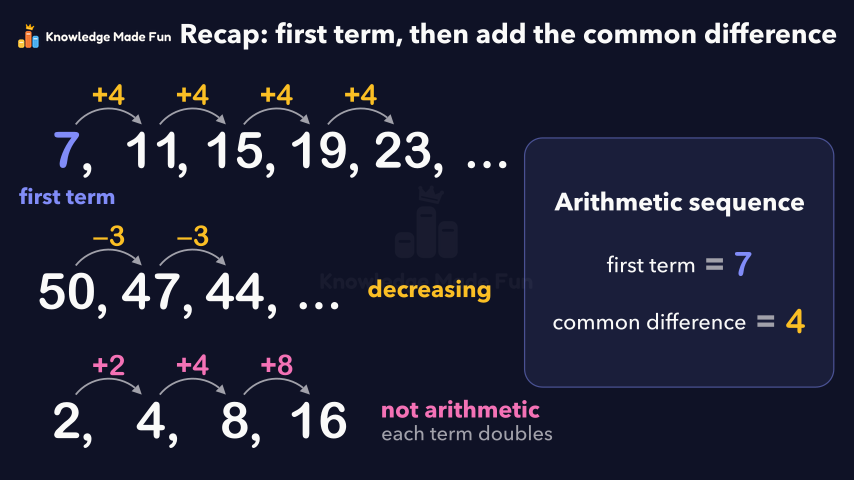 2 min 4 s
Arithmetic sequences: first term and common difference
Grade 10 · 2 min 4 s 2 min 8 s
Four Kinds of Slope: Uphill, Downhill, Flat and a Wall
Grade 10 · 2 min 8 s 2 min 16 s
General form, and changing between the forms of a line
Grade 10 · 2 min 16 s 2 min 5 s
Parallel and perpendicular lines: equal slopes and negative reciprocals
Grade 10 · 2 min 5 s 2 min 4 s
Point-slope form: a line from one point and its slope
Grade 10 · 2 min 4 s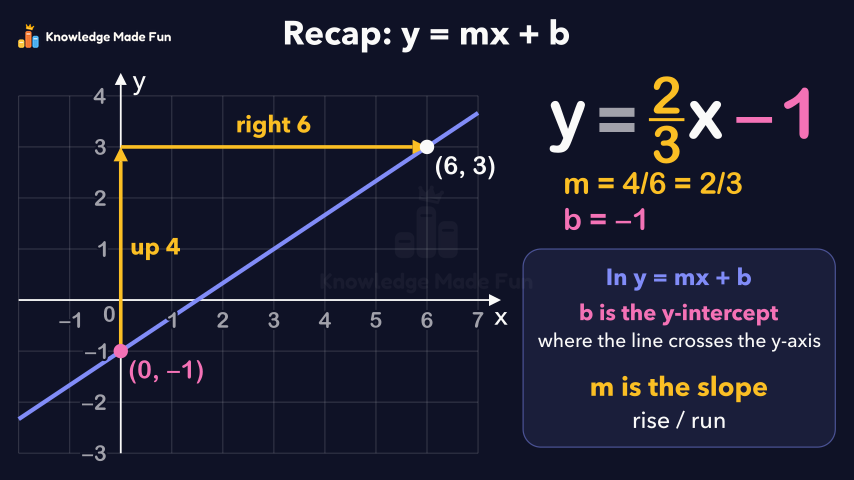 2 min 9 s
Slope-intercept form: graphing y = 2/3x − 1
Grade 10 · 2 min 9 s
- All Grade 9 Mathematics lessons
- Try the graph paper, free for everyone, no account needed.
- Create a free account to watch three lessons a day, no payment and no card.