Lesson · Grade 10 · Foundations of Mathematics and Pre Calculus
Arithmetic Sequences Are Linear: The Common Difference Is the Slope
- Grade 10
- Foundations of Mathematics and Pre Calculus
- 2 min 11 s
- British Columbia
- BC10-MA-22
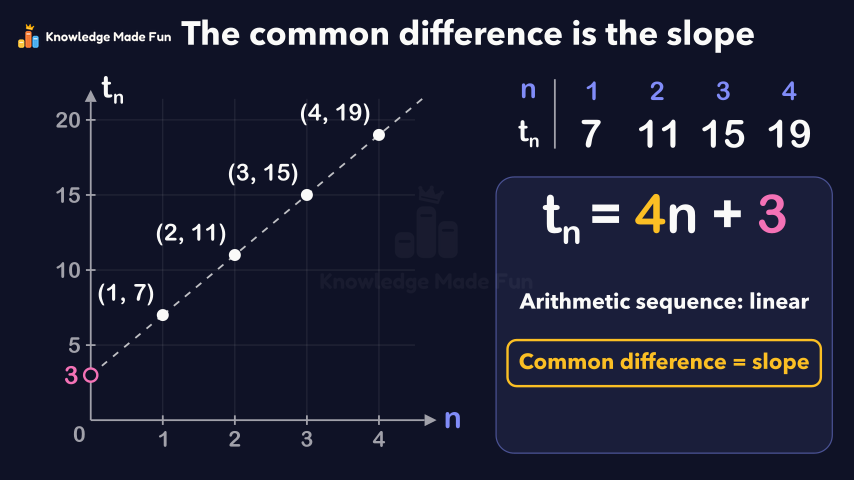
The terms of 7, 11, 15, 19 are plotted against their positions as (1, 7) to (4, 19), and each step of across 1, up 4 gives a straight line with slope 4, the common difference. Stepping back to n = 0 gives the intercept 7 − 4 = 3, so the rule is tₙ = 4n + 3. It is checked on every term, and the video corrects the mistake of using the first term as the intercept.
Concept: Arithmetic sequences are linear: the difference is the slope
Anyone can watch two lessons on the website without an account. Signing in is free, no payment and no card, and opens three a day; Plus has no limit.
Loading
In one sentence
The question this lesson answers
What does the sequence 7, 11, 15, 19 look like on a graph? Each number is a term.
Each term is 4 more than the one before. This fixed jump is the common difference, so this is an arithmetic sequence.
Transcript
What the lesson says
What does the sequence 7, 11, 15, 19 look like on a graph? Each number is a term.
Each term is 4 more than the one before. This fixed jump is the common difference, so this is an arithmetic sequence.
To graph it, number the positions: n equals 1, 2, 3 and 4. The term at position n is called t sub n.
Plot each pair as a point, with n across and t sub n up: 1 and 7, 2 and 11, 3 and 15, 4 and 19.
From each point to the next, n goes across by 1 and the term goes up by 4.
Slope tells how steep a line is: rise over run. Here, 4 over 1 is 4, the common difference.
Every step is the same, so the points lie on a straight line: the sequence is linear.
Where would the line cross the vertical axis? Step back to n equals 0: 7 minus 4 is 3. That point is the intercept.
A slope of 4 and an intercept of 3 give the rule t sub n equals 4 n plus 3.
Check: 4 times 1 plus 3 is 7, 4 times 2 plus 3 is 11, 4 times 3 plus 3 is 15, and 4 times 4 plus 3 is 19.
A common mistake is to use the first term as the intercept. But 7 is at n equals 1, not n equals 0.
The rule 4 n plus 7 would give 4 times 1 plus 7, which is 11, not 7.
The points stay apart because n counts positions: 1, 2, 3 and so on. There is no term at n equals 2.5.
So an arithmetic sequence is linear, and its common difference is the slope.
Curriculum
Where this fits
- British Columbia, Grade 10
Foundations of Mathematics and Pre Calculus 10, Linear relations: arithmetic sequencesBC10-MA-22
Previous: The General Term of an Arithmetic SequenceNext: Adding an Arithmetic Series by Pairing Terms
The outcomes and strands follow the British Columbia curriculum.
Keep going
 2 min 18 s
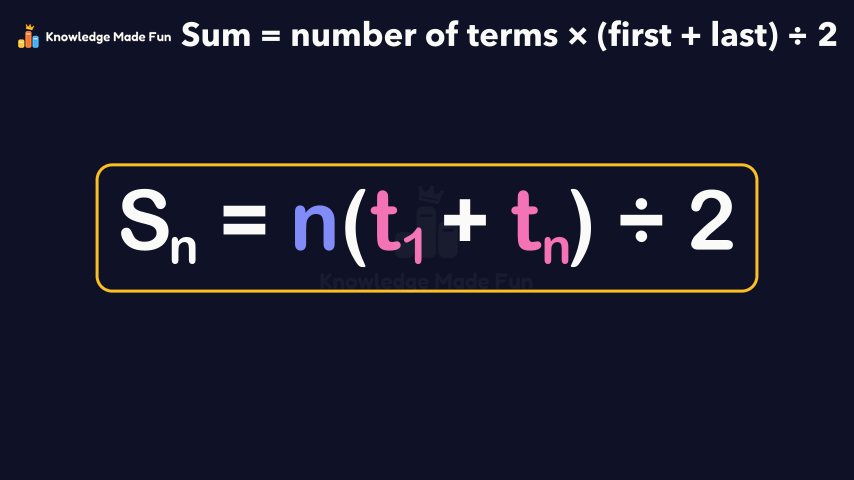
Adding an Arithmetic Series by Pairing Terms
Grade 10 · 2 min 18 s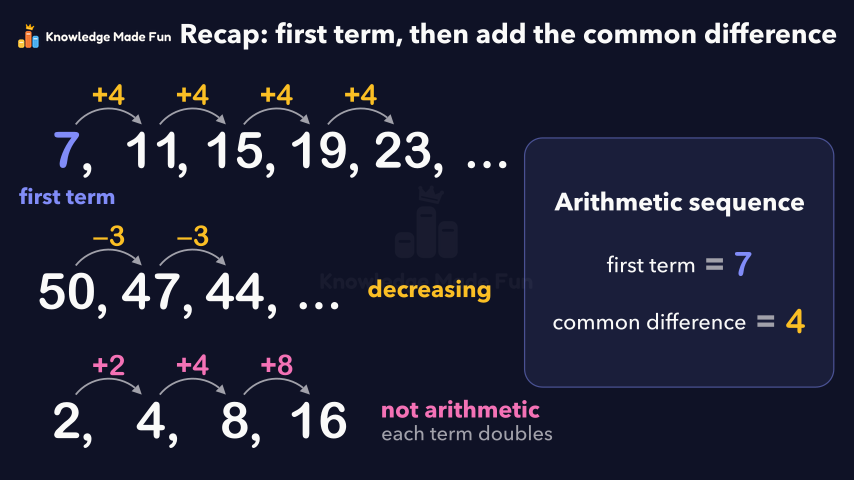 2 min 4 s
Arithmetic sequences: first term and common difference
Grade 10 · 2 min 4 s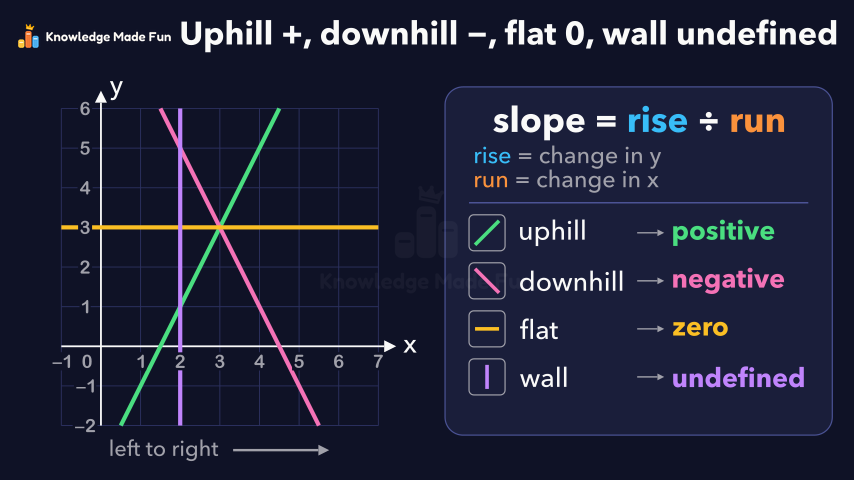 2 min 8 s
Four Kinds of Slope: Uphill, Downhill, Flat and a Wall
Grade 10 · 2 min 8 s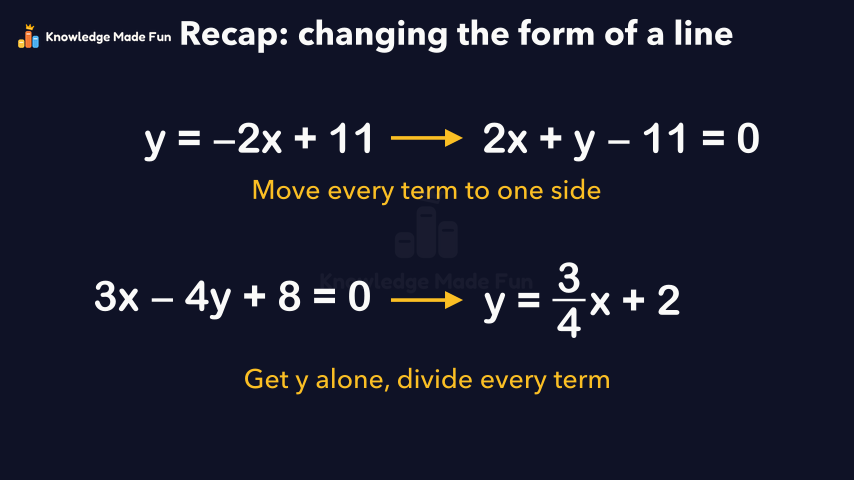 2 min 16 s
General form, and changing between the forms of a line
Grade 10 · 2 min 16 s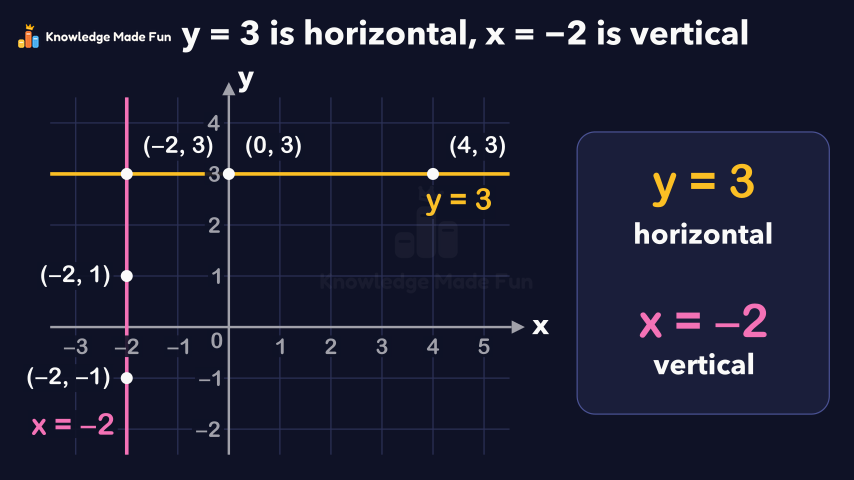 2 min 1 s
Horizontal and vertical lines: y = 3 and x = −2
Grade 9 · 2 min 1 s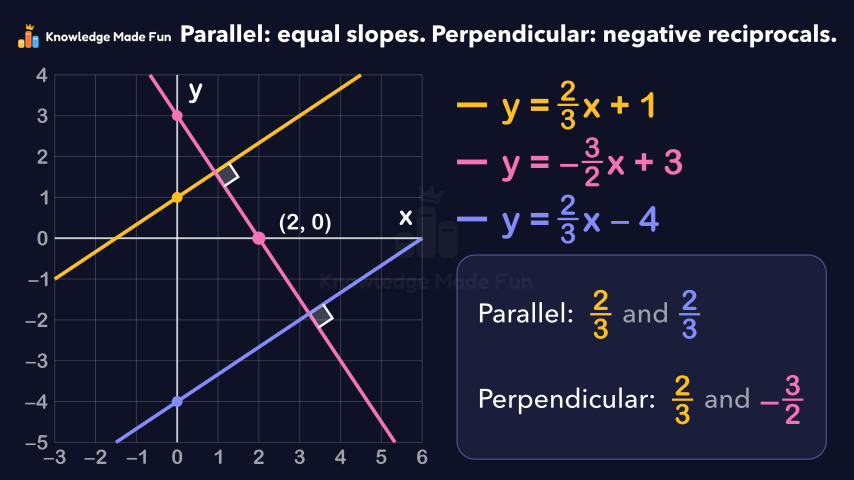 2 min 5 s
Parallel and perpendicular lines: equal slopes and negative reciprocals
Grade 10 · 2 min 5 s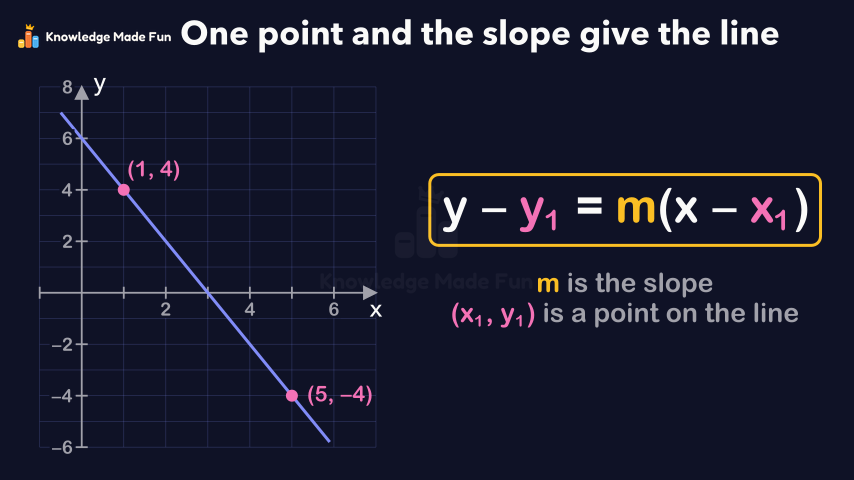 2 min 4 s
Point-slope form: a line from one point and its slope
Grade 10 · 2 min 4 s 2 min 9 s
Slope-intercept form: graphing y = 2/3x − 1
Grade 10 · 2 min 9 s
- All Grade 10 Foundations of Mathematics and Pre Calculus lessons
- Create a free account to watch three lessons a day, no payment and no card.