Lesson · Grade 10 · Foundations of Mathematics and Pre Calculus
The General Term of an Arithmetic Sequence
- Grade 10
- Foundations of Mathematics and Pre Calculus
- 2 min 29 s
- British Columbia
- BC10-MA-21
Using the sequence 7, 11, 15, …, the video names terms, term numbers and the common difference d = 4, then shows that reaching each term takes one fewer jump of 4 than its term number, which leads to tₙ = t₁ + (n − 1)d and t₂₀ = 7 + 19 × 4 = 83 (and warns that 7 + 20 × 4 = 87 is the 21st term). It then simplifies the rule to tₙ = 4n + 3, checks it with n = 1 and n = 20, and works backwards to show that 103 is the 25th term, checked as 7 + 24 × 4 = 103.
Anyone can watch two lessons on the website without an account. Signing in is free, no payment and no card, and opens three a day; Plus has no limit.
Loading
In one sentence
The question this lesson answers
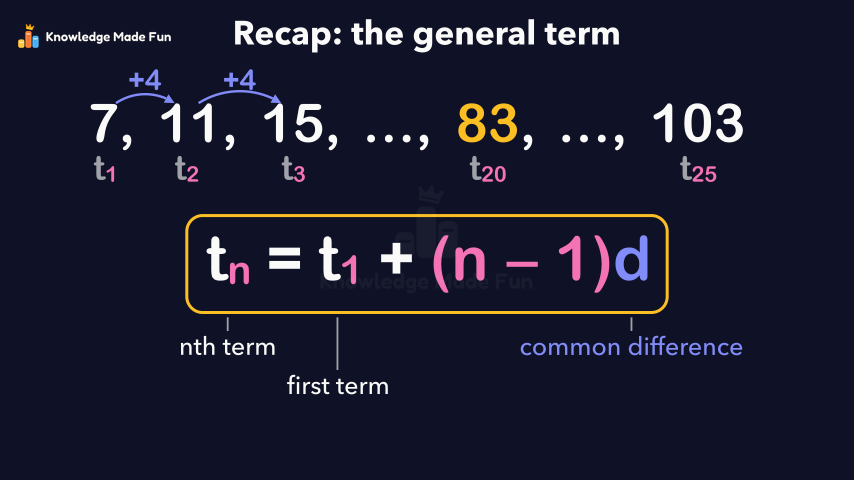
Here is a sequence: 7, 11, 15, and so on. What is its 20th term?
Each number in the list is a term: t sub 1, t sub 2, t sub 3, and so on.
Transcript
What the lesson says
Here is a sequence: 7, 11, 15, and so on. What is its 20th term?
Each number in the list is a term: t sub 1, t sub 2, t sub 3, and so on.
Here n is the term number, so t sub n is the nth term.
In an arithmetic sequence, we add the same amount each time.
That amount is the common difference, d. 11 minus 7 is 4, and 15 minus 11 is 4, so d is 4.
Start at t sub 1, which is 7. To reach t sub 2, add one 4. To reach t sub 3, add two 4s.
The number of 4s is one less than the term number, so t sub 20 needs 19 of them.
This gives the general term: t sub n equals t sub 1, plus n minus 1, times d.
For the 20th term, put in n equals 20, t sub 1 equals 7, and d equals 4.
20 minus 1 is 19, 19 times 4 is 76, and 7 plus 76 is 83. The 20th term is 83.
Careful: multiply by n minus 1, not by n. 7 plus 20 times 4 is 87, the 21st term.
We can simplify the general term. Put in t sub 1 equals 7 and d equals 4.
Expand the brackets to get 7 plus 4n minus 4, then collect like terms: 4n plus 3.
Check: 4 times 1 plus 3 is 7, and 4 times 20 plus 3 is 83.
Now work backwards: which term is 103?
Set 4n plus 3 equal to 103. Subtract 3 to get 4n equals 100, then divide by 4: n equals 25.
Check: t sub 25 is 7 plus 24 times 4, which is 7 plus 96, or 103.
To sum up: the nth term is the first term plus n minus 1 common differences.
Curriculum
Where this fits
- British Columbia, Grade 10
Foundations of Mathematics and Pre Calculus 10, Linear relations: arithmetic sequencesBC10-MA-21
Previous: Arithmetic sequences: first term and common differenceNext: Arithmetic Sequences Are Linear: The Common Difference Is the Slope
The outcomes and strands follow the British Columbia curriculum.
Keep going
 2 min 18 s
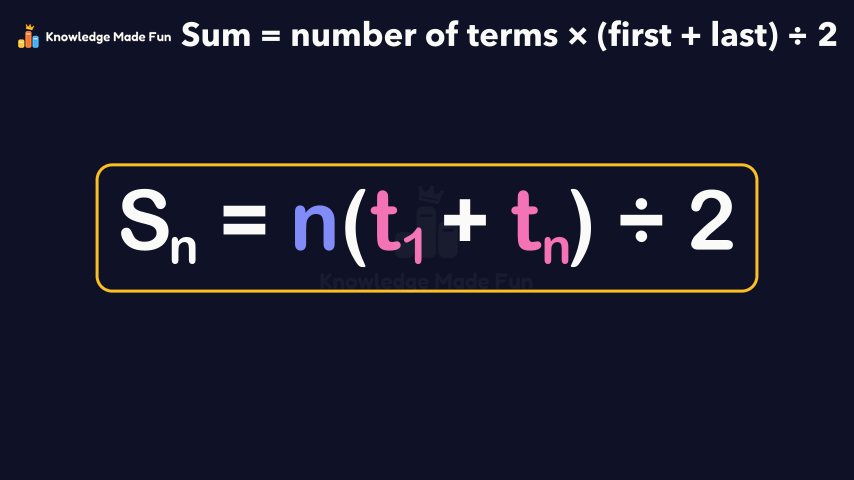
Adding an Arithmetic Series by Pairing Terms
Grade 10 · 2 min 18 s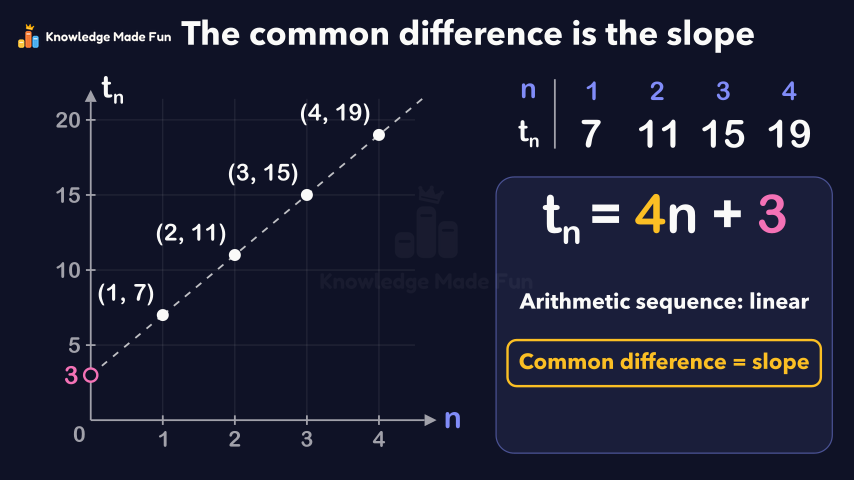 2 min 11 s
Arithmetic Sequences Are Linear: The Common Difference Is the Slope
Grade 10 · 2 min 11 s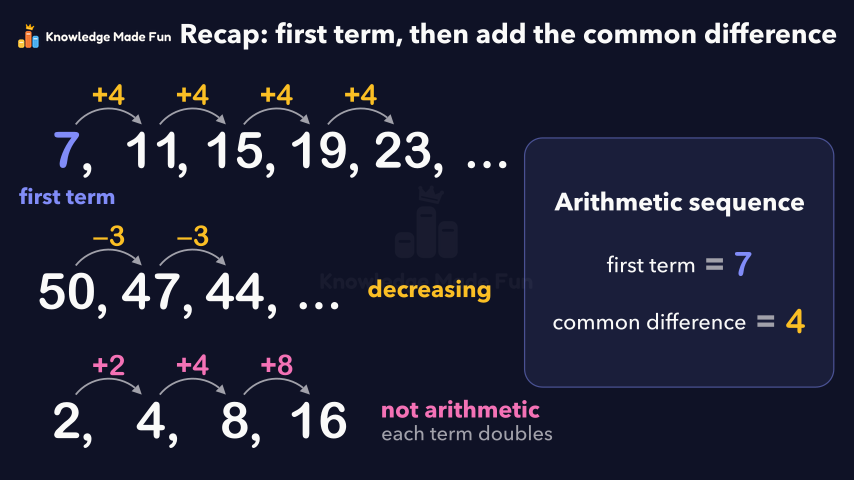 2 min 4 s
Arithmetic sequences: first term and common difference
Grade 10 · 2 min 4 s 2 min 8 s
Four Kinds of Slope: Uphill, Downhill, Flat and a Wall
Grade 10 · 2 min 8 s 2 min 16 s
General form, and changing between the forms of a line
Grade 10 · 2 min 16 s 2 min 1 s
Horizontal and vertical lines: y = 3 and x = −2
Grade 9 · 2 min 1 s 2 min 5 s
Parallel and perpendicular lines: equal slopes and negative reciprocals
Grade 10 · 2 min 5 s 2 min 4 s
Point-slope form: a line from one point and its slope
Grade 10 · 2 min 4 s
- All Grade 10 Foundations of Mathematics and Pre Calculus lessons
- Create a free account to watch three lessons a day, no payment and no card.