Lesson · Grade 8 · Mathematics
Surface Area of a Triangular Prism
- Grade 8
- Mathematics
- 2 min 6 s
- British Columbia
- BC8-MA-25
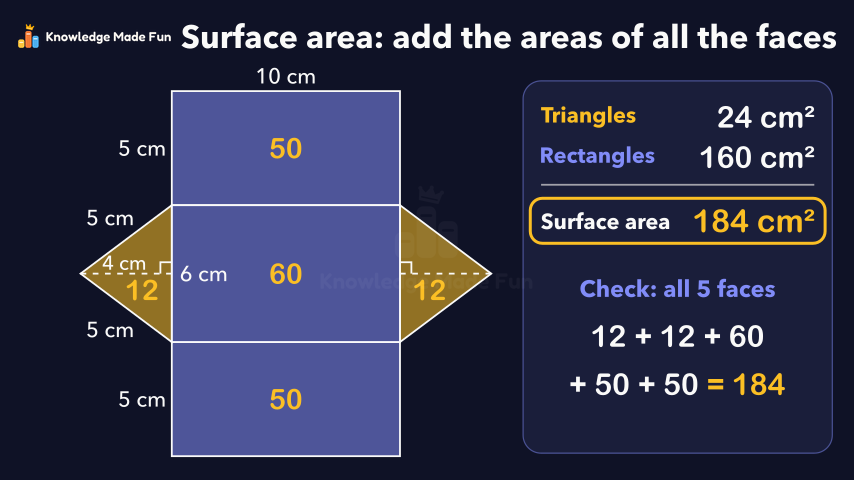
A tent-shaped prism 10 cm long, with triangle ends of base 6 cm, height 4 cm and sloped sides 5 cm, is unfolded into a net so all five faces can be seen. The two triangles (24 cm²) and three rectangles (160 cm²) are added to give a surface area of 184 cm², with a warning not to use the 4 cm height for the sloped rectangles and a face-by-face check.
Anyone can watch two lessons on the website without an account. Signing in is free, no payment and no card, and opens three a day; Plus has no limit.
Loading
In one sentence
The question this lesson answers
This tent shape is a triangular prism. What is its surface area?
Surface area is the total area of all the faces. A face is one flat surface of the solid.
Transcript
What the lesson says
This tent shape is a triangular prism. What is its surface area?
Surface area is the total area of all the faces. A face is one flat surface of the solid.
Its two ends are matching triangles, joined by three rectangles, so it has five faces.
Each triangle has a base of 6 centimetres, a height of 4 centimetres and sloped sides of 5 centimetres. The prism is 10 centimetres long.
The height goes straight up from the base to the top corner, at a right angle to the base.
Unfold the prism into a net: a flat shape that folds up to make the solid.
A triangle's area is base times height divided by 2. So 6 times 4 divided by 2 is 12 square centimetres.
There are two triangles, so 2 times 12 is 24 square centimetres.
The bottom rectangle is 6 by 10, so its area is 60 square centimetres.
A common mistake with the sloped rectangles is to use the 4 centimetre height, and work out 4 times 10. But the height is not one of their edges.
Each sloped rectangle is as wide as the triangle's sloped side, 5 centimetres. So each one is 5 times 10, which is 50 square centimetres.
Add the three rectangles: 60 plus 50 plus 50 is 160 square centimetres.
So the surface area is 24 plus 160, which is 184 square centimetres.
Check by adding all five faces: 12 plus 12 plus 60 plus 50 plus 50 is 184.
To find surface area, add the areas of all the faces. Here it is 184 square centimetres.
Curriculum
Where this fits
- British Columbia, Grade 8
Mathematics, Geometry and measurement: surface area and volume of regular solids, including triangular and other right prisms and cylindersBC8-MA-25
Previous: Surface area: add the areas of every faceNext: Surface area of a cylinder: two circles and a rectangle
The outcomes and strands follow the British Columbia curriculum.
Keep going
 1 min 12 s
3:15 p.m. or 15:15? Morning, afternoon and the 24-hour clock
Grade 4 · 1 min 12 s 1 min 26 s
3D Objects: Faces, Edges and Vertices
Grade 3 · 1 min 26 s 1 min 21 s
Area and Perimeter: What Is the Difference?
Grade 5 · 1 min 21 s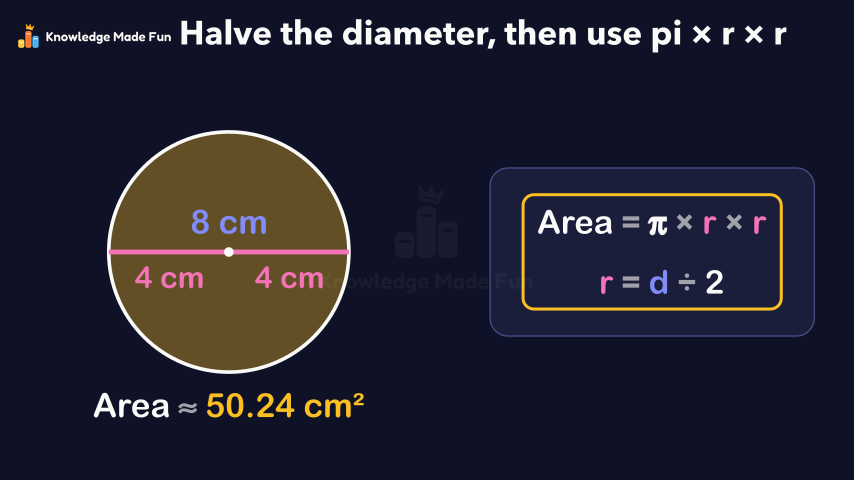 1 min 5 s
Area of a Circle from the Radius or the Diameter
Grade 7 · 1 min 5 s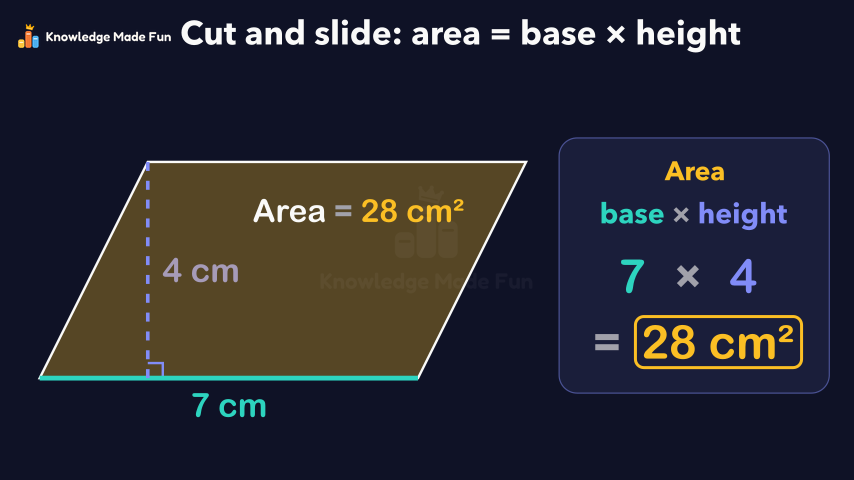 1 min 14 s
Area of a Parallelogram: Cut and Slide into a Rectangle
Grade 6 · 1 min 14 s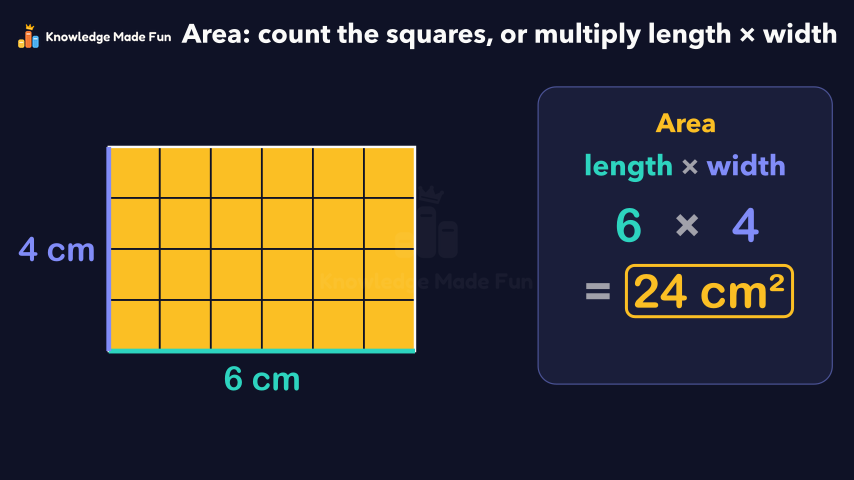 1 min 18 s
Area of a Rectangle: Count the Squares, Then Multiply
Grade 5 · 1 min 18 s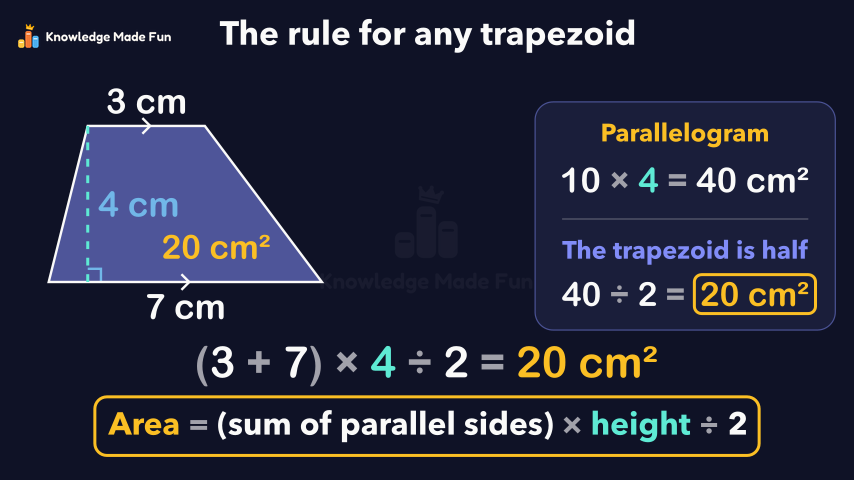 1 min 16 s
Area of a Trapezoid: Two Copies Make a Parallelogram
Grade 6 · 1 min 16 s 1 min 19 s
Area of a Triangle: Half of a Parallelogram
Grade 6 · 1 min 19 s
- All Grade 8 Mathematics lessons
- Try the graph paper, free for everyone, no account needed.
- Create a free account to watch three lessons a day, no payment and no card.