Lesson · Grade 11 · Pre Calculus
The Ambiguous Case: Two Triangles from the Same Facts
- Grade 11
- Pre Calculus
- 2 min 10 s
- British Columbia
- BC11-MA-81
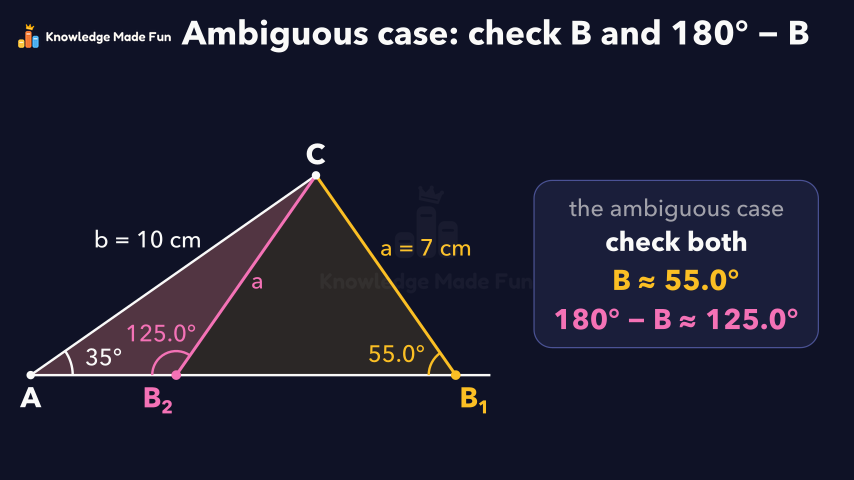
Given A = 35°, a = 7 cm and b = 10 cm, side a swings from C like a gate and meets the base line twice. The sine law gives sin B ≈ 0.819, so B ≈ 55.0° or 125.0°, and both angles make a triangle. Comparing a with the height b sin A ≈ 5.74 cm then shows when there are no triangles, one right triangle, two triangles or one triangle, ending on the rule to always check both B and 180° − B.
Anyone can watch two lessons on the website without an account. Signing in is free, no payment and no card, and opens three a day; Plus has no limit.
Loading
In one sentence
The question this lesson answers
Can the same facts about a triangle give two different triangles?
Angle A is 35 degrees, side b is 10 centimetres, and side a, opposite angle A, is 7 centimetres.
Transcript
What the lesson says
Can the same facts about a triangle give two different triangles?
Angle A is 35 degrees, side b is 10 centimetres, and side a, opposite angle A, is 7 centimetres.
Side a must reach the base line, so swing it like a gate hinged at C.
It meets the line twice, at B one and B two, so two triangles fit the same facts.
Two sides and an angle not between them is the ambiguous case: more than one triangle can fit.
To find angle B, use the sine law: sine B over b equals sine A over a.
So sine B equals 10 times sine 35 degrees over 7, about 0.819.
The inverse sine key turns the sine back into an angle: B is about 55 degrees.
But 180 minus 55 is 125 degrees, and its sine is also 0.819.
Both fit with A: 35 plus 55 is 90, and 35 plus 125 is 160, both under 180 degrees.
At B one the angle is 55 degrees; at B two it is 125 degrees, an obtuse angle, over 90.
A common mistake is keeping only the calculator's angle and missing a triangle.
With A acute, under 90 degrees, compare a with the height from C, which is b times sine A, about 5.74 centimetres.
If a is shorter than the height, there is no triangle; if equal, one right triangle.
If a is between the height and b, like our 7 centimetres, there are two; if a is at least b, just one.
In the ambiguous case, always check both B and 180 degrees minus B.
Curriculum
Where this fits
- British Columbia, Grade 11
Pre Calculus 11, Trigonometry: trigonometry: non-right triangles and angles in standard positionBC11-MA-81
Previous: The cosine law: two sides and the angle between themNext: Angles in Standard Position and Reference Angles
The outcomes and strands follow the British Columbia curriculum.
Keep going
 2 min 3 s
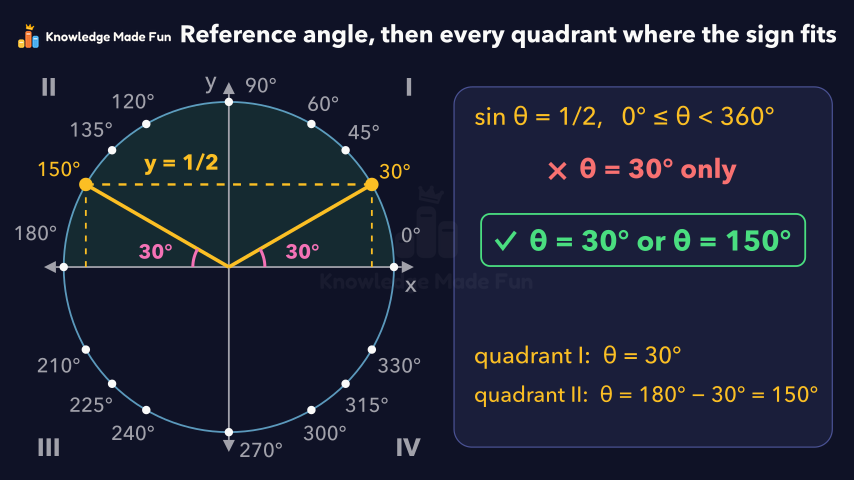
Angles in Standard Position and Reference Angles
Grade 11 · 2 min 3 s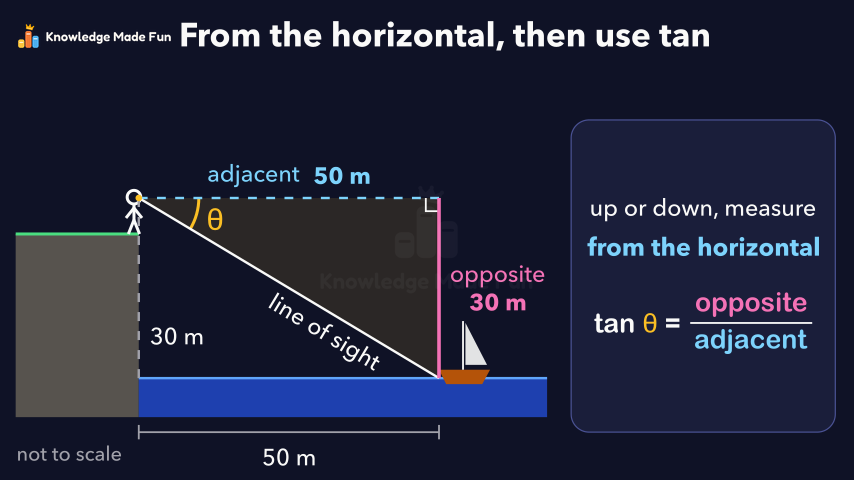 2 min 12 s
Angles of Elevation and Depression: Measuring What You Cannot Reach
Grade 10 · 2 min 12 s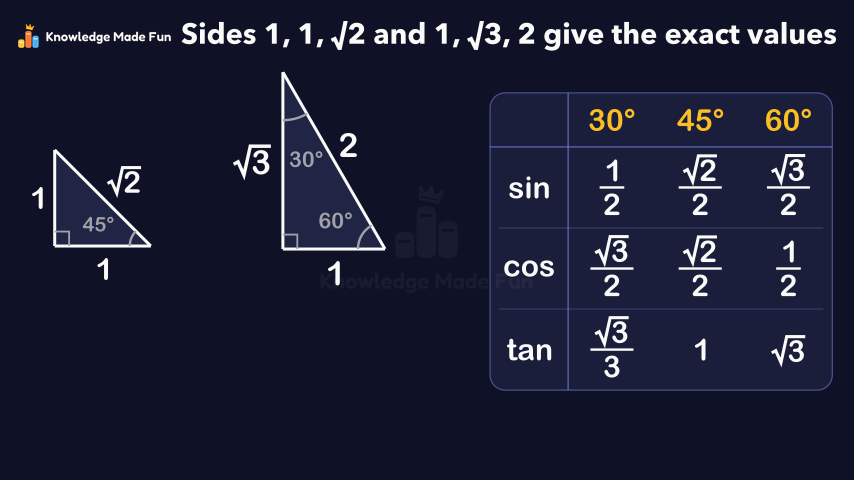 2 min 3 s
Exact Values from the Special Triangles
Grade 11 · 2 min 3 s 2 min 23 s
Finding a Missing Angle with Inverse Tan
Grade 10 · 2 min 23 s 2 min 11 s
Finding a missing side with a trig ratio
Grade 10 · 2 min 11 s 1 min 45 s
Naming the Sides of a Right Triangle: Hypotenuse, Opposite, Adjacent
Grade 10 · 1 min 45 s 2 min 13 s
Sine, cosine and tangent: the three trig ratios
Grade 10 · 2 min 13 s 2 min 11 s
Solving a Right Triangle: Pythagoras and Trig
Grade 10 · 2 min 11 s
- All Grade 11 Pre Calculus lessons
- Create a free account to watch three lessons a day, no payment and no card.