Lesson · Grade 10 · Foundations of Mathematics and Pre Calculus
Naming the Sides of a Right Triangle: Hypotenuse, Opposite, Adjacent
- Grade 10
- Foundations of Mathematics and Pre Calculus
- 1 min 45 s
- British Columbia
- BC10-MA-34
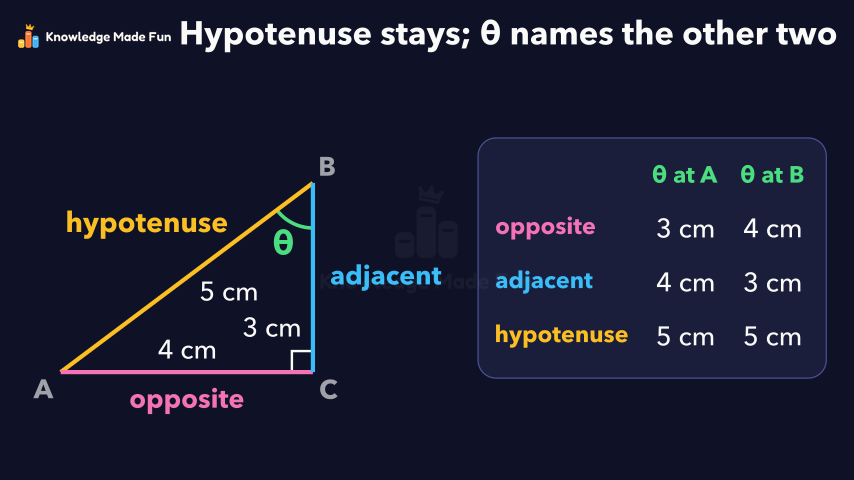
A 3 cm, 4 cm, 5 cm right triangle is labelled step by step: the hypotenuse is the side across from the right angle, then with θ marked at one corner, the opposite side is across from θ and the adjacent side touches θ but is not the hypotenuse. When θ moves to the other corner, the opposite and adjacent labels visibly swap while the hypotenuse stays the same, and a table records both cases; the video also warns against calling the hypotenuse adjacent just because it touches θ.
Concept: Naming the sides of a right triangle: opposite, adjacent, hypotenuse
Anyone can watch two lessons on the website without an account. Signing in is free, no payment and no card, and opens three a day; Plus has no limit.
Loading
In one sentence
The question this lesson answers
Each side of a right triangle has its own name. Which side is which?
The small square at C marks the right angle, which is exactly 90 degrees.
Transcript
What the lesson says
Each side of a right triangle has its own name. Which side is which?
The small square at C marks the right angle, which is exactly 90 degrees.
Our triangle has sides of 3 centimetres, 4 centimetres and 5 centimetres.
Check: 3 squared plus 4 squared is 9 plus 16, which is 25, and 5 squared is also 25.
The hypotenuse is the side across from the right angle. It is always the longest side, here 5 centimetres.
Now pick one of the other two angles and mark it with theta, a Greek letter used for angles.
The opposite side is across from theta. It does not touch theta at all.
Adjacent means next to. The adjacent side touches theta and is not the hypotenuse.
Careful: the hypotenuse touches theta too, but it is never called the adjacent side.
So with theta at A, opposite is 3 centimetres, adjacent is 4 centimetres and the hypotenuse is 5 centimetres.
Now move theta to the other corner, at B.
Opposite and adjacent swap. The 4 centimetre side is now across from theta, and the 3 centimetre side touches it.
With theta at B, opposite is 4 centimetres, adjacent is 3 centimetres and the hypotenuse is still 5 centimetres.
The hypotenuse stays across from the right angle, and theta names the other two sides: opposite and adjacent.
Curriculum
Where this fits
- British Columbia, Grade 10
Foundations of Mathematics and Pre Calculus 10, Trigonometry: primary trigonometric ratiosBC10-MA-34
- British Columbia, Grade 10
Workplace Mathematics 10, Trigonometry: primary trigonometric ratiosBC10-MA-47
The outcomes and strands follow the British Columbia curriculum.
Keep going
 2 min 3 s
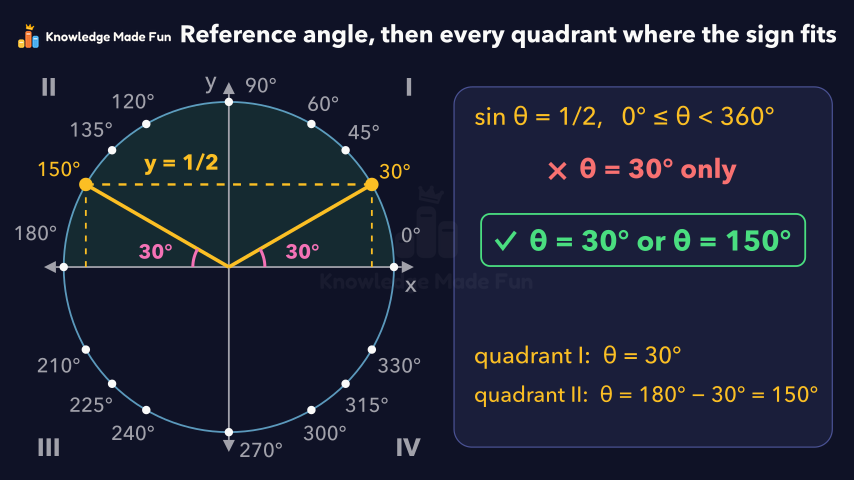
Angles in Standard Position and Reference Angles
Grade 11 · 2 min 3 s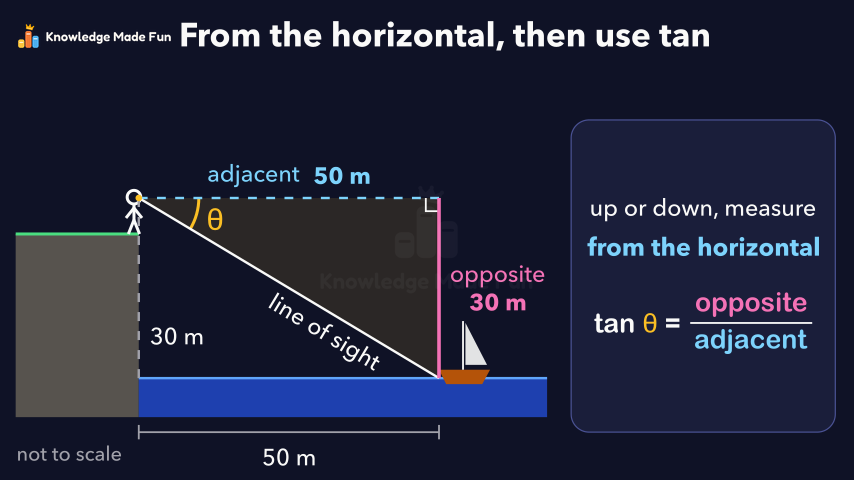 2 min 12 s
Angles of Elevation and Depression: Measuring What You Cannot Reach
Grade 10 · 2 min 12 s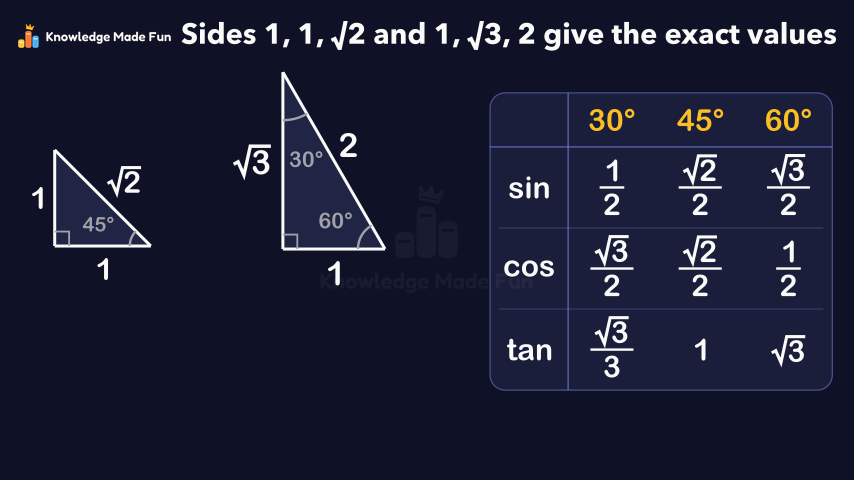 2 min 3 s
Exact Values from the Special Triangles
Grade 11 · 2 min 3 s 2 min 23 s
Finding a Missing Angle with Inverse Tan
Grade 10 · 2 min 23 s 2 min 11 s
Finding a missing side with a trig ratio
Grade 10 · 2 min 11 s 2 min 13 s
Sine, cosine and tangent: the three trig ratios
Grade 10 · 2 min 13 s 2 min 11 s
Solving a Right Triangle: Pythagoras and Trig
Grade 10 · 2 min 11 s 2 min 6 s
Solving Trigonometric Equations from 0° to 360°
Grade 11 · 2 min 6 s
- All Grade 10 Foundations of Mathematics and Pre Calculus lessons
- Create a free account to watch three lessons a day, no payment and no card.