Lesson · Grade 10 · Foundations of Mathematics and Pre Calculus
Domain and Range from a Graph and a Situation
- Grade 10
- Foundations of Mathematics and Pre Calculus
- 2 min 8 s
- British Columbia
- BC10-MA-09
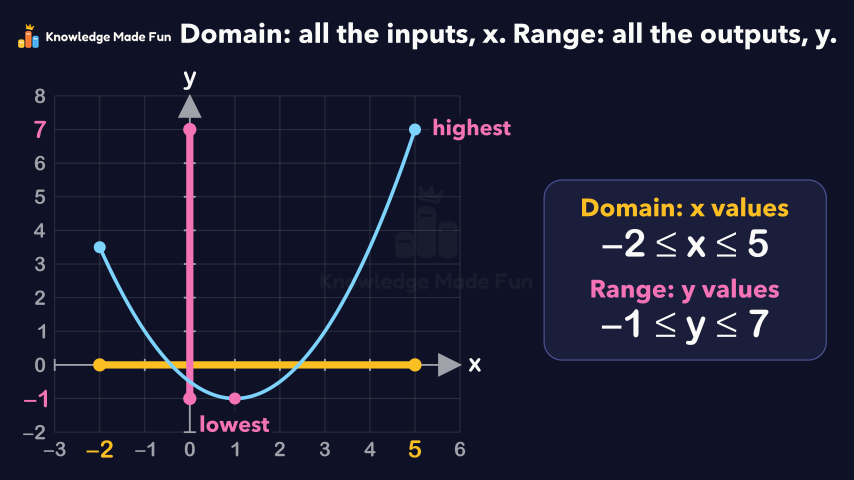
A parabola drawn from x = −2 to x = 5 casts a shadow on each axis, giving a domain of −2 ≤ x ≤ 5 and a range of −1 ≤ y ≤ 7. A 4-hour hike at 3 km each hour then gives a domain of 0 ≤ t ≤ 4 and a range of 0 ≤ d ≤ 12; the video also corrects the mistake of swapping domain and range, and shows that tickets sold can only be whole numbers from 0 to 8.
Concept: Domain and range from a graph and from a situation
Anyone can watch two lessons on the website without an account. Signing in is free, no payment and no card, and opens three a day; Plus has no limit.
Loading
In one sentence
The question this lesson answers
Here is the graph of a function. Which x values and which y values does it use?
The graph starts at x equals negative 2 and stops at x equals 5. Solid dots mean both ends are included.
Transcript
What the lesson says
Here is the graph of a function. Which x values and which y values does it use?
The graph starts at x equals negative 2 and stops at x equals 5. Solid dots mean both ends are included.
The domain is all the x values, the inputs. The graph's shadow on the x-axis runs from negative 2 to 5.
So the domain is negative 2 less than or equal to x, less than or equal to 5.
The range is all the y values, the outputs. The graph's shadow on the y-axis runs from the lowest point, negative 1, to the highest, 7.
So the range is negative 1 less than or equal to y, less than or equal to 7.
Now a situation: a hiker walks 3 kilometres each hour for 4 hours, so 3 times 4 is 12 kilometres.
Time, t, is the input. The hike lasts 4 hours, so the domain is 0 less than or equal to t, less than or equal to 4.
Distance, d, is the output, so the range is 0 less than or equal to d, less than or equal to 12 kilometres.
A common mistake is to swap them. The domain is not 0 to 12: that is the distance, so it is the range.
The domain is the inputs, along the horizontal axis. The range is the outputs, up the vertical axis.
Time can be any value from 0 to 4, like 2.5 hours, but you cannot sell half a ticket.
With 8 seats to sell, the domain for tickets sold is the whole numbers 0 to 8: dots, not a solid line.
So the domain is all the inputs, the x values, and the range is all the outputs, the y values.
Curriculum
Where this fits
- British Columbia, Grade 10
Foundations of Mathematics and Pre Calculus 10, Functions: functions and relations: connecting data, graphs, and situationsBC10-MA-09
Previous: The vertical line testNext: Function notation: what f(3) means
The outcomes and strands follow the British Columbia curriculum.
Keep going
 2 min 10 s
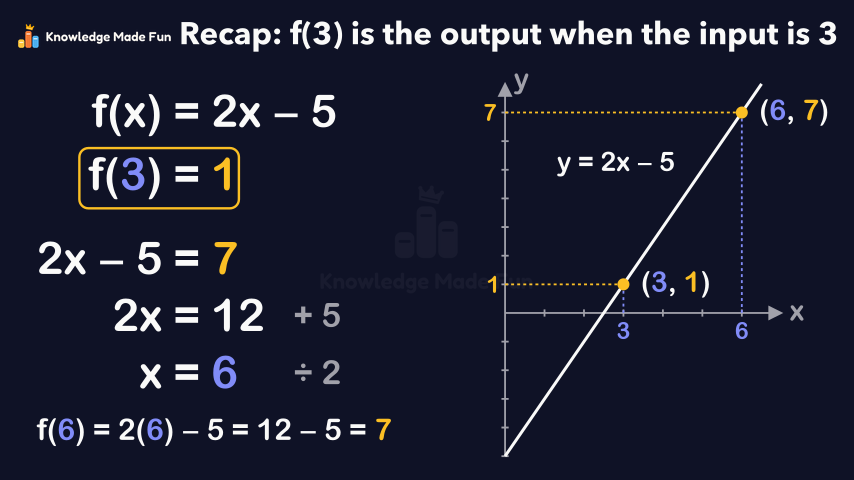
Function notation: what f(3) means
Grade 10 · 2 min 10 s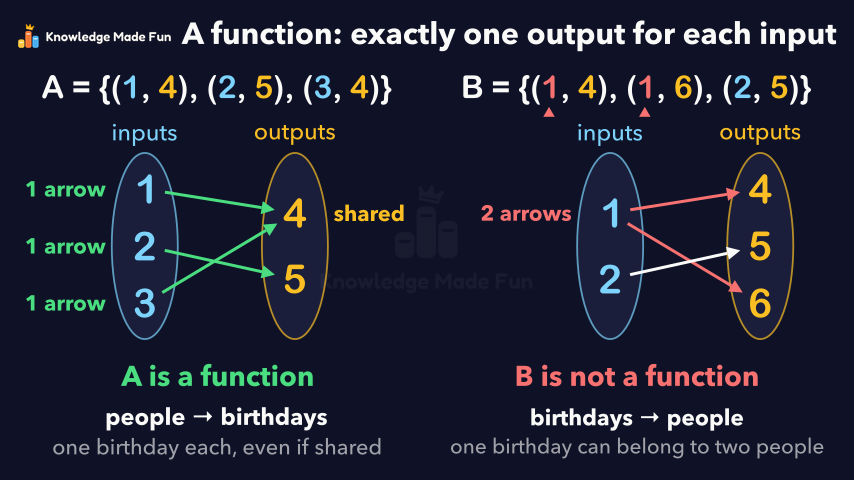 1 min 55 s
Relations and Functions: One Output for Each Input
Grade 10 · 1 min 55 s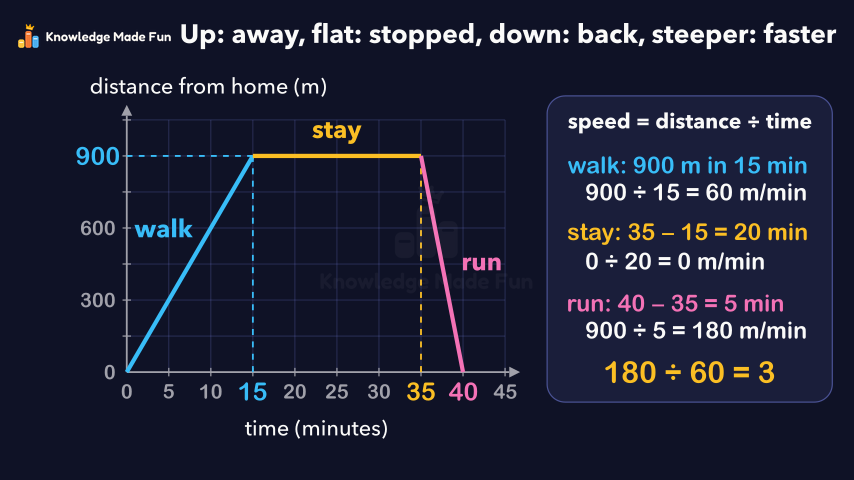 2 min 8 s
Telling the story of a graph
Grade 10 · 2 min 8 s 1 min 59 s
The vertical line test
Grade 10 · 1 min 59 s 2 min 18 s
Adding an Arithmetic Series by Pairing Terms
Grade 10 · 2 min 18 s 2 min 12 s
Angles of Elevation and Depression: Measuring What You Cannot Reach
Grade 10 · 2 min 12 s 2 min 11 s
Arithmetic Sequences Are Linear: The Common Difference Is the Slope
Grade 10 · 2 min 11 s 2 min 4 s
Arithmetic sequences: first term and common difference
Grade 10 · 2 min 4 s
- All Grade 10 Foundations of Mathematics and Pre Calculus lessons
- Create a free account to watch three lessons a day, no payment and no card.